
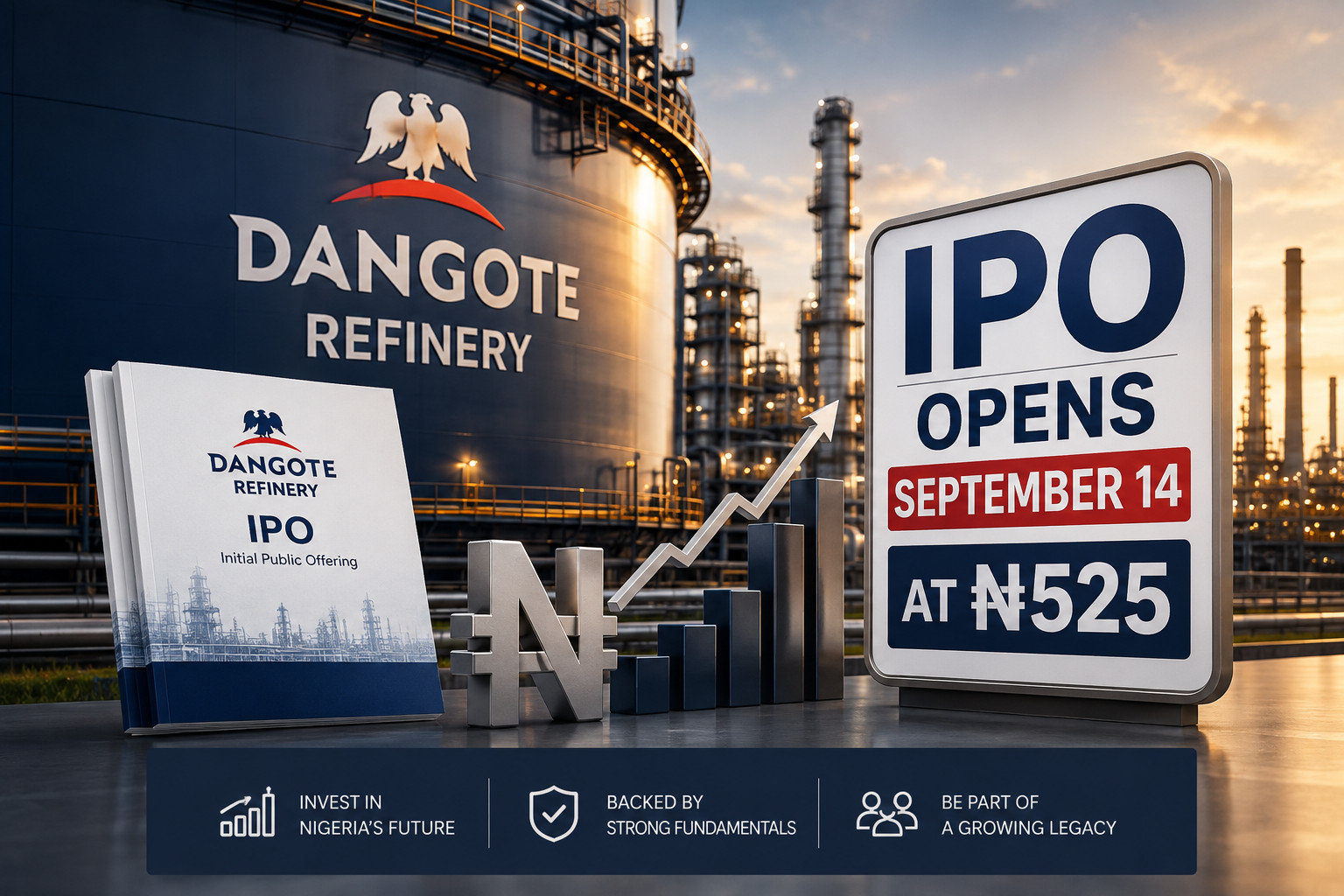
September 14, 2026. That is the day the order book opens for the most consequential IPO in Nigeria’s capital market history, and one of the most significant equity offerings on the African continent in decades. The Dangote Petroleum Refinery and Petrochemicals FZE is going public. Nigeria’s Securities and Exchange Commission has approved it. The price is set. The shares are ready. And you have nine days to make a decision. You definitely want to put this date and bookmark in your calendar right now.
Let me walk you through everything you need to understand before that date arrives.
On Thursday, September 4, Aliko Dangote, speaking to investors in Botswana, confirmed that the IPO would open within the next ten to twelve days. That placed the opening at September 14. Hours later, the SEC made the regulatory confirmation that removed any remaining uncertainty.
The SEC approved the IPO in a letter addressed to Vetiva Advisory Services Limited, the lead issuing house for the offer, signed by Abdulkadir Abbas, Director of the Securities and Investment Services Department. The letter formally cleared the company’s draft offer documents and authorised it to proceed to a completion board meeting and signing ceremony.
The approval also registered the company’s existing 120.13 billion ordinary shares.
Here is the number you need to hold: the IPO will involve the issuance of 4.1 billion shares at N525 per share, with the potential to raise approximately N2.15 trillion if fully subscribed. That is roughly $1.55 billion at the current exchange rate.
The N525 per share figure is not an arbitrary number. The IPO is coming at an indicative price range of N500 to N595 per share, with N525 as the mid-point. It sits toward the lower end of that range, which tells you something about where the advisers believe the offer needs to be priced to attract the broadest possible participation.
The offer includes a 15 percent over-allotment option, also called a green shoe, to accommodate excess demand from institutional investors, domestic pension funds, and regional African buyers. That option exists because the people structuring this deal expect demand to exceed the base offering.
The Dangote Group plans to float approximately five to ten percent of the refinery’s total equity through the IPO on the NGX. This is not a full privatisation. It is a minority stake offer designed to raise capital for the next phase of expansion while keeping control firmly in Dangote’s hands.
Now let me tell you what this means for Aliko Dangote personally, because I think you should know this number.
Dangote holds 92.3 percent of the refinery, approximately 110.88 billion shares, which at the offer price are worth roughly N58.21 trillion, or $41.88 billion. His stake dilutes to about 89.25 percent after the offer.
The Bloomberg Billionaires Index put his total wealth at $35.3 billion on August 30, carrying the refinery at roughly its construction cost of $20 billion. Marking it at the offer price would add about $23.42 billion, taking him toward $58.7 billion and making him one of the twenty wealthiest people in the world.
Personally I want you to sit with that for a moment. A refinery built on Nigerian soil, funded largely with Nigerian debt, processing Nigerian crude, could make its founder one of the twenty richest people in human history. Whatever you think of Dangote, whatever you think of how this business was built, that is a fact worth sitting with. Because it means African capital, deployed at scale on African soil, can produce outcomes that compete with anything the world’s most celebrated entrepreneurs have built.
Primary proceeds are earmarked to fund the expansion of the Lagos mega-refinery from its current 700,000 barrels per day operational baseline to 1.4 million barrels per day.
That expansion, if it happens on schedule, would make the Dangote Refinery the largest single refining facility on the planet. The current nameplate capacity of 650,000 barrels per day already makes it Africa’s largest. The refinery reached full nameplate capacity in February 2026.
Nigeria’s oil refining sector recorded its strongest quarterly growth in the second quarter of 2026, expanding by 43.94 percent year-on-year, according to the National Bureau of Statistics Q2 2026 GDP report, as increased output from the Dangote Refinery lifted domestic refining activity.
And the export story is even sharper than the domestic one. Data from the US Energy Information Administration showed that Nigeria’s seaborne refined petroleum exports to Europe surged by approximately 767 percent, a figure driven almost entirely by Dangote Refinery output entering international markets.
Read that again. Seven hundred and sixty-seven percent. Nigeria, a country that spent decades importing refined petroleum products despite sitting on some of the world’s largest crude reserves, is now exporting refined fuel to Europe at a rate that has grown nearly eightfold in a single year.
I need to tell you about one specific structural element of this IPO, because it is genuinely unusual for a Nigerian listing and it will matter to a lot of people reading this.
Aliko Dangote has previously indicated plans to structure a unique dividend framework for the refinery. The proposal aims to allow investors to purchase shares in Naira on the NGX while receiving dividends paid out in US Dollars, supported by the refinery’s substantial foreign exchange earning export streams.
Think about what that means for a Nigerian investor. You buy shares in naira. Your dividends arrive in dollars. In an economy where naira depreciation has been one of the defining financial anxieties of the past decade, a naira-entry, dollar-exit investment structure in a company generating hard currency from fuel exports to Europe is not a small thing.
Get instant alerts and updates based on your interests. Be the first to know when big stories happen.
This feature, if it is fully implemented as described, changes the risk profile of this investment significantly for Nigerian retail investors. It does not eliminate risk. The refinery’s performance, the oil price environment, and the execution of the expansion plan all remain variables that no dividend structure can neutralise. But the dollar dividend proposal tells you that whoever structured this offer understood the Nigerian investor’s primary anxiety, and tried to address it directly.
Dangote did not only announce the IPO date on Thursday. He also revealed two additional developments that I want you to note.
A Dangote Cement secondary listing on the London Stock Exchange is likely in October 2026. That listing, if it proceeds on schedule, will give international investors another entry point into the Dangote ecosystem beyond the refinery.
Dangote also revealed plans to launch a major coastal refinery project in Kenya on September 30, in partnership with East African governments. The Kenya refinery is expected to take approximately three years to complete and will supply the East African market.
I want you to see the full picture here. The Dangote Refinery IPO is not a single transaction. It is the first move in an expansion strategy that, if it unfolds as announced, will position one Nigerian business as the dominant refining force across two of Africa’s most economically significant regions, West and East Africa, within the next decade.
So Should You Buy?
I am not a licensed financial adviser, and this article is not investment advice. What I am is a journalist who has read every detail of this offer and will give you the honest frame.
The bull case is clear. A refinery already at full capacity. A domestic market of 220 million people that still imports significant quantities of fuel. Export revenue growing at rates that are rewriting Nigeria’s trade data. A dollar dividend structure that hedges your naira risk. And a brand name, Dangote, that carries more commercial credibility in Nigeria and across Africa than almost any other.
The risks are also real. The expansion from 700,000 to 1.4 million barrels per day is an enormous engineering and financing undertaking. The global oil price environment remains volatile, and refining margins can compress quickly when crude input costs rise against product prices. Nigeria’s regulatory and operating environment carries risks that any capital market filing will describe in careful language but that any experienced Nigerian investor already understands in their bones.
What I will say is this. September 14 is not a deadline for a decision you have not thought about. It is a deadline for a decision that, if you have been watching Nigerian markets and the Nigerian economy for any length of time, you have probably already been forming an opinion on.
The shares are N525. The books open in nine days. The decision is yours.