

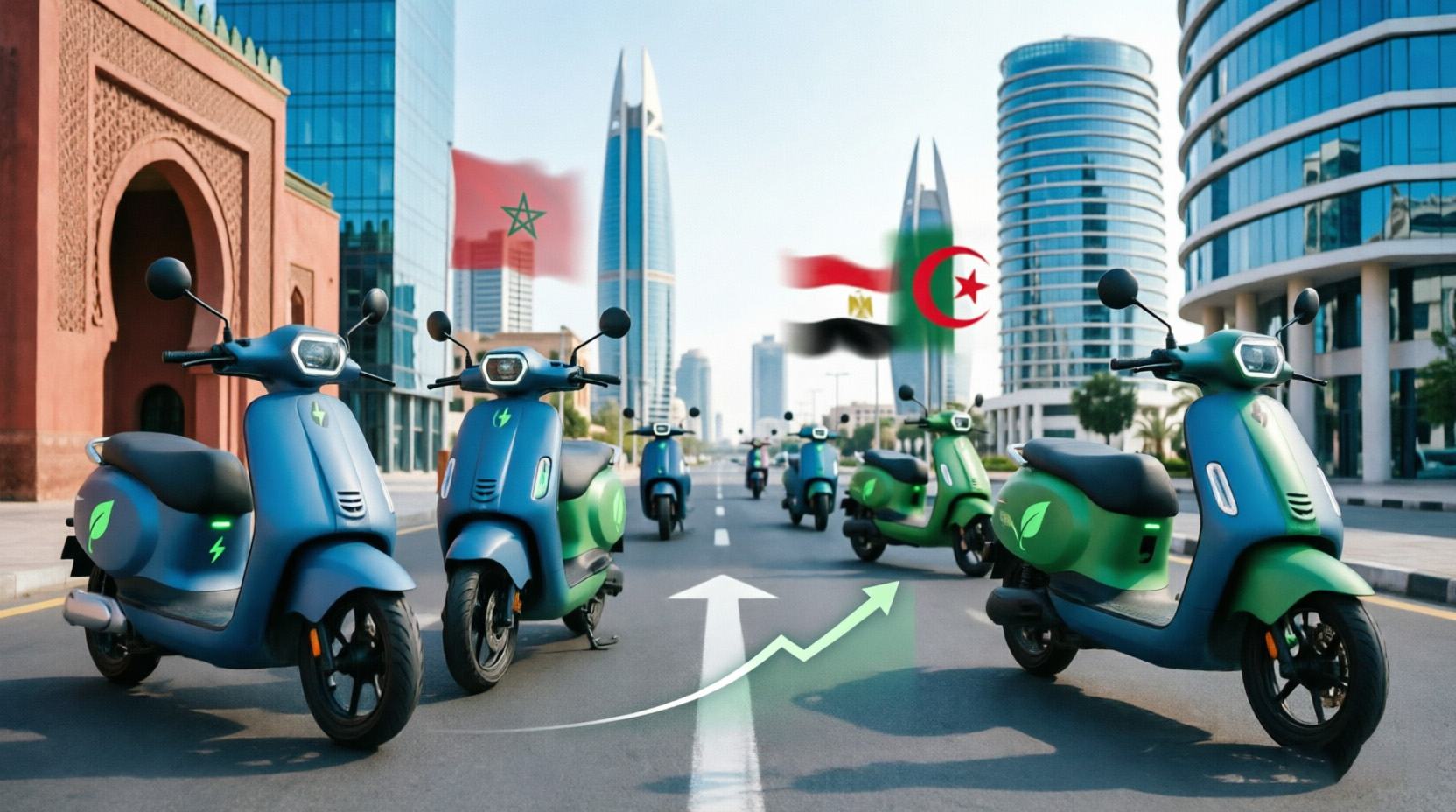
North Africa is rapidly becoming one of Africa’s biggest markets for electric motorcycles and scooters, with Morocco, Egypt and Algeria driving a sharp increase in imports from China.
And the numbers tell a rather interesting story.
During the first half of 2026, Africa imported $114.6 million worth of electric motorcycles and three-wheelers from China, representing an increase of almost 60% compared with the same period a year earlier.
But here is the interesting part: the countries driving this surge are not necessarily the places where Africa’s electric-mobility startups are building the most infrastructure.
They are importing the vehicles.
And Morocco is leading the charge.
Morocco Imported More Than 80,000 Electric Two – and Three-Wheelers
According to data reported by the Associated Press, Morocco imported 80,188 electric motorcycles and three-wheelers worth $21.7 million during the first half of 2026.
Egypt and Algeria followed as other major destinations for Chinese electric two-wheelers.
That tells us something important about the way electric mobility is developing in different parts of Africa.
The transition is not happening in one uniform way.
In North Africa, consumers are increasingly buying electric scooters and mopeds for everyday transportation.
In other parts of the continent, electric motorcycles are increasingly being treated as commercial tools.
And that difference could shape Africa’s electric-vehicle industry for years to come.
Why Are Chinese Electric Bikes Finding a Market in North Africa?
The answer is relatively straightforward.
Price.
Chinese manufacturers have spent years building enormous production capacity for electric two-wheelers. That gives them the ability to produce large numbers of scooters and motorcycles at prices that can be considerably more accessible than many alternatives.
For consumers in cities where commuting costs are rising, an electric scooter can offer an attractive alternative.
There is no need for petrol.
There is less mechanical complexity than with a conventional combustion engine.
And for short urban journeys, range may not be the biggest problem.
This makes the electric scooter particularly attractive to private consumers.
Peter Kossakowski, an independent specialist in electric two- and three-wheelers who has worked across Africa, told AP that Chinese imports in North Africa are largely electric scooters and mopeds purchased by consumers for commuting and short trips.
In other words, North Africa’s electric-bike boom is, for now, largely a consumer mobility story.
But Look South and the Story Changes
Now move south.
The electric motorcycle market in East and West Africa looks considerably different.
In countries where motorcycles are heavily used for passenger transport, delivery services and informal commerce, an electric motorcycle is not simply a means of getting from home to work.
It is a business asset.
A motorcycle taxi operator may spend hours on the road every day.
A delivery rider may cover dozens or even hundreds of kilometres.
That means the economics are completely different.
The question becomes:
How quickly can the motorcycle recharge?
And that is where battery swapping becomes important.
The Battery Problem
Imagine a motorcycle taxi rider who depends on his bike to earn money.
If the battery runs empty, the rider cannot simply stop working for several hours while waiting for it to charge.
Every hour off the road potentially means lost income.
This is why companies operating in East and West Africa are increasingly developing battery-swapping networks.
Instead of waiting for a battery to recharge, riders can exchange a depleted battery for a charged one at a designated station.
It turns the battery into something closer to a fuel tank that can be exchanged rather than refilled.
For commercial riders, that could be transformative.
Kossakowski told AP that commercial riders in East and West Africa can travel as much as 150 kilometres a day, making battery-swapping infrastructure particularly important.
Africa Is Developing Two Different Electric-Mobility Markets
This is perhaps the most interesting part of the story.
Africa is not developing one electric-mobility market.
It is developing several.
In North Africa, imported electric scooters are increasingly being used by individual consumers for commuting and short-distance travel.
In parts of East and West Africa, electric motorcycles are being developed around commercial transportation, delivery and motorcycle-taxi businesses.
That distinction matters because the infrastructure required for each market is different.
A consumer who rides 20 or 30 kilometres a day may be perfectly comfortable charging at home.
A commercial rider travelling 100 or 150 kilometres every day needs something much more sophisticated.
They need reliable charging or battery swapping.
They need financing.
They need spare parts.
They need maintenance networks.
And they need motorcycles designed specifically for African operating conditions.
Local Assembly Could Be the Next Big Step
There is another development worth watching.
Africa does not necessarily want to remain a market where Chinese companies simply manufacture electric motorcycles and ship them into the continent.
A growing number of companies are attempting to establish local assembly and manufacturing ecosystems.
This is particularly visible in East and Central Africa, where companies are combining electric motorcycles with battery-swapping infrastructure and commercial transport networks.
That could eventually change the economics of the industry.
Instead of importing complete motorcycles, African countries could increasingly import components, assemble vehicles locally and eventually manufacture more of the components domestically.
That would create jobs and potentially reduce supply-chain costs.
But getting there will require significant investment.
Spiro Is Betting Big on the African Market
One company attracting considerable attention is Spiro, an electric motorcycle company operating across several African markets.
The company has reportedly raised more than $348 million in investment over the past year, supporting its expansion of electric motorcycles, battery-swapping infrastructure and related ecosystems.
Spiro’s approach illustrates the difference between simply selling electric motorcycles and building an electric-mobility business.
The motorcycle is only one part of the equation.
The battery is another.
Then there is the charging or swapping network.
Then financing.
Then maintenance.
Then data.
Then fleet management.
The companies that eventually dominate African electric mobility may therefore not necessarily be the companies selling the cheapest motorcycles.
They may be the companies capable of building the entire ecosystem around those motorcycles.
Why This Matters for Africa’s Fuel Bill
There is also a much bigger economic argument behind the shift.
Africa imports enormous quantities of petroleum products.
Every motorcycle that moves from petrol to electricity potentially reduces the amount of fuel required for transportation.
Get instant alerts and updates based on your interests. Be the first to know when big stories happen.
At a national level, the effect could become significant if millions of motorcycles eventually transition to electric power.
And this is not only about climate change.
It is also about economics.
Electric mobility can reduce exposure to fluctuations in international oil prices, potentially lower operating costs for transport businesses and reduce urban air pollution.
That makes electric motorcycles particularly interesting for African cities.
But Cheap Imports Are Not the Same as a Successful EV Industry
There is a warning hidden inside the import numbers.
Importing tens of thousands of electric motorcycles does not automatically mean that a country has developed a sustainable electric-vehicle industry.
The real test comes later.
Who repairs the motorcycles?
Where do replacement batteries come from?
What happens when a battery reaches the end of its useful life?
Are spare parts readily available?
Can consumers obtain affordable financing?
Can governments establish appropriate safety and technical standards?
And perhaps most importantly:
What happens to the batteries after they are no longer useful?
These questions will become increasingly important as Africa’s electric two-wheeler fleet expands.
The Chinese Factor
China’s role in Africa’s electric-mobility transition is impossible to ignore.
Chinese manufacturers currently supply a significant proportion of the electric motorcycles and components entering African markets.
But African companies are increasingly adapting those products to local realities.
And that distinction is important.
Africa does not simply need electric motorcycles designed for Chinese cities.
It needs motorcycles capable of dealing with African roads, African weather, African transport patterns and African commercial realities.
The winning products may therefore be those that combine Chinese manufacturing economics with African engineering and business models.
The numbers suggest that electric two-wheelers are moving beyond being a niche experiment.
Morocco’s more than 80,000 imported units in just six months is significant.
And when Egypt and Algeria are added to the picture, it becomes clear that North Africa is emerging as a major destination for China’s electric two-wheelers.
But the bigger African story may eventually be somewhere else.
It may be in the streets of Lagos, Nairobi, Kampala, Accra, Kigali and other cities where motorcycles are not simply personal transportation but part of the informal and formal economy.
There, the electric motorcycle has to do more than look attractive.
It has to make money.
It has to survive long working days.
It has to be affordable.
And most importantly, it has to stay on the road.
That is why Africa’s electric-mobility race is not really about who imports the most motorcycles.
It is about who builds the ecosystem that makes electric transportation economically sustainable.
North Africa appears to be winning the consumer-import race.
East and West Africa are experimenting with commercial models, battery swapping and local assembly.
The next few years will reveal which approach becomes the more powerful model for the continent.
And if the current import figures are anything to go by, Africa’s transition from petrol-powered two-wheelers to electric mobility may already be moving faster than many people realise.