

If someone told you that six Nigerian men could allegedly spend years pretending to be romantic partners to women they had never met, convince those women to send them millions of dollars, and then have an international manhunt eventually lead to their extradition from South Africa to the United States, you might think it sounds like the plot of a crime film.
But this is not fiction.
It is a real case that has taken five years to move from arrest in South Africa to extradition to the United States.
And the amount of money involved is staggering: more than $6 million allegedly taken from over 100 American women.
So, what exactly happened?
It Started With Online Romance
Let us break this down simply.
A romance scam is not necessarily about someone immediately asking you for money.
In fact, that is often the point.
The scammer first wants your trust.
Imagine receiving messages from someone who appears interested in you. You talk every day. They ask about your life. They remember details about your family. They tell you about their own struggles. Gradually, the person stops feeling like a stranger.
You begin to believe there is a genuine relationship.
And that is when the financial requests can begin.
According to investigators, that was essentially the model allegedly used in this case.
The victims were reportedly women in the United States, including pensioners and businesspeople. More than 100 women were allegedly targeted.
The relationship was the bait.
The money was the objective.
But Why South Africa?
This is where the story becomes much bigger than a simple online dating scam.
The six Nigerian suspects were arrested in South Africa in 2021.
Think about that for a moment.
The alleged victims were in America.
The suspects were Nigerians.
The arrests happened in South Africa.
And the investigation involved American and South African authorities working across borders.
This is what modern cybercrime increasingly looks like.
The person sending you a message may be thousands of kilometres away. The bank account receiving your money may belong to another person. The proceeds can move through several countries.
By the time investigators start connecting the dots, the crime scene is no longer one city or even one country.
It is international.
Five Years Behind Bars and in the Courts
The suspects were not simply arrested in South Africa and immediately placed on a plane to America.
That is not how extradition works.
After their arrests in 2021, legal proceedings continued in South Africa over whether they could be surrendered to American authorities.
That process took years.
Now, in September 2026, the process has reached another major stage.
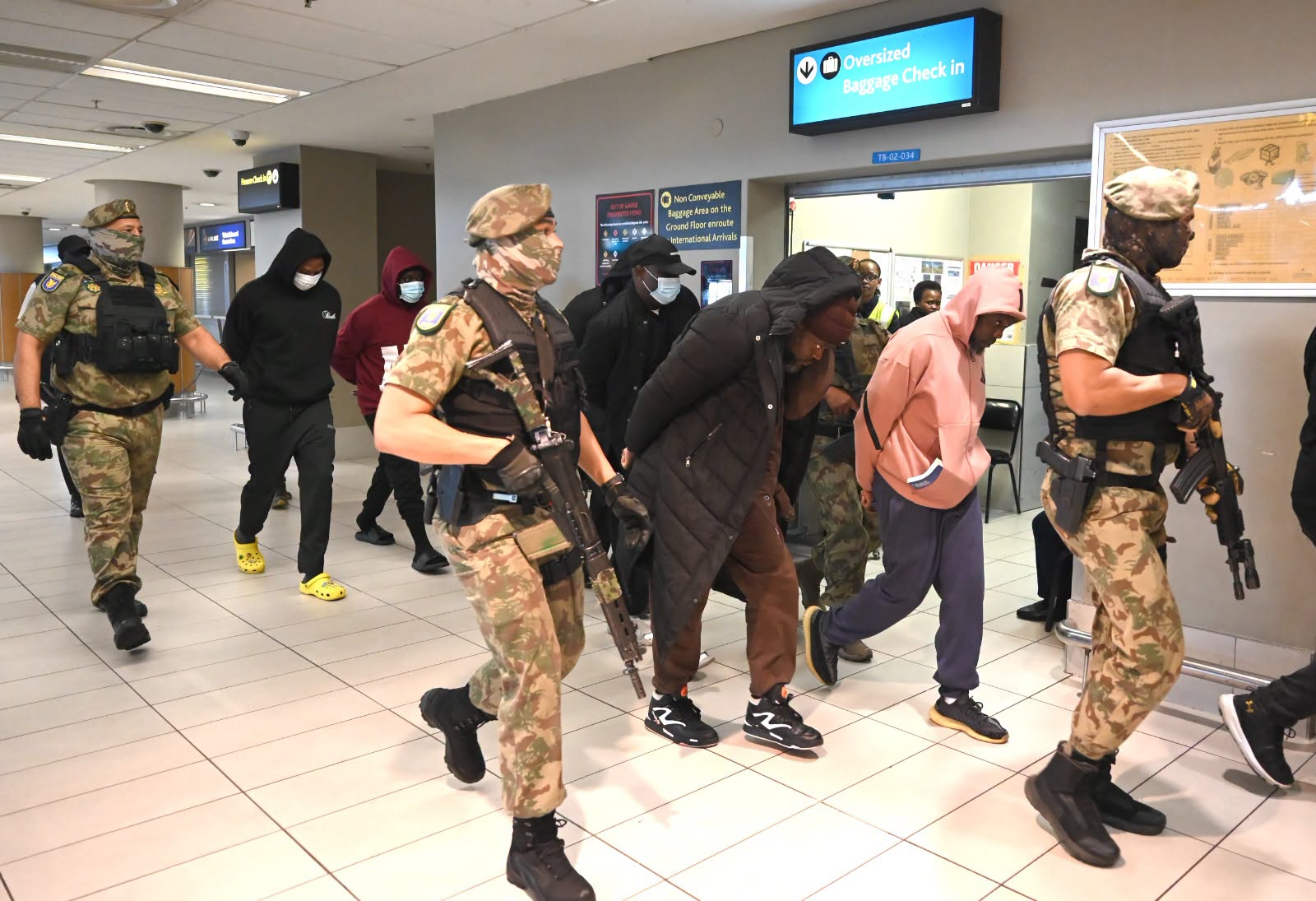
The six men have been extradited to the United States, where they are expected to face charges including wire fraud and money laundering.
They were handed over to American officials from the FBI and US Secret Service at Cape Town International Airport.
Interpol South Africa was also involved in coordinating the transfer.
So, after roughly five years, the case has effectively moved into a new phase.
meanwhile here are names of the accused persons; Perry Osagiede, Collins Owhofsa Otughwor, Osariemen Eric Clement, Musa Mudashiri, Franklyn Edosa Osagiede, and Prince Ibeabuchi Mark. All said to be members of The Black Axe Confraternity whom are allegedly known for cybercrime, election fraud, human trafficking, drug trafficking, money laundering, and murder (allegedly).
More Than $6 Million Allegedly Stolen
Now let’s talk about the money.
South African authorities have put the alleged losses at more than R100 million, equivalent to roughly $6.2 million.
And this is where the numbers become important.
We are not talking about one victim who lost money to one dishonest person.
Authorities say more than 100 women were allegedly targeted.
That means the alleged operation was not simply a personal scam between two people. Investigators believe there was an organised structure behind it.
And that is also why authorities have reportedly linked the suspects to Black Axe, a Nigerian organised criminal network that has been associated by international law-enforcement agencies with cyber-enabled fraud.
But there is an important distinction we must make here.
Being accused of having links to an organisation does not mean that a person has been proven guilty of belonging to that organisation or committing the crimes alleged.
That determination belongs to the courts.
The six defendants are presumed innocent unless proven guilty.
The Human Cost Is Bigger Than the Dollar Figure
When we hear “$6 million romance scam,” it is easy to focus on the money.
But consider what the victims allegedly believed they were losing.
For some, it may have been retirement savings.
For others, money accumulated over decades.
But there is another kind of damage that does not appear on a bank statement.
Trust.
Imagine discovering that someone you spent months talking to, someone who knew your fears and your personal stories, someone you thought genuinely cared about you, was allegedly never real.
That is why romance fraud can be particularly devastating.
The victim is not simply being tricked into making a financial transaction.
They are allegedly being manipulated emotionally first.
The money comes later.
And This Is Why These Scams Keep Working
Here is the uncomfortable part.
People often ask:
“How could anyone be so foolish?”
That is probably the wrong question.
The better question is:
“How sophisticated has online manipulation become?”
Because scammers understand human behaviour.
They know that lonely people want companionship.
They know that people experiencing difficult moments can be vulnerable.
They know that trust can be built through daily conversations.
And they know that if you can make someone believe that you genuinely care about them, asking for financial assistance later becomes much easier.
This is not necessarily about intelligence.
It is about manipulation.
The Bigger African Cybercrime Problem
The extradition also highlights something governments across Africa have been struggling with for years.
Cybercrime does not respect borders.
A criminal network can recruit people in one country, target victims in another, use financial accounts in a third and move proceeds through yet another jurisdiction.
Get instant alerts and updates based on your interests. Be the first to know when big stories happen.
Law enforcement therefore has to operate in exactly the opposite way.
It has to cooperate.
South Africa cannot investigate every American victim on its own.
The United States cannot simply arrest suspects living in another country.
Interpol, police agencies, prosecutors, financial institutions and courts have to work together.
And when they do, cases that once appeared almost impossible to prosecute can eventually reach court.
Why This Case Matters to Nigerians
There is also a Nigerian dimension that cannot be ignored.
Nigeria has spent years battling the international reputation associated with internet fraud.
The vast majority of Nigerians are obviously not criminals. Millions of Nigerians are building legitimate businesses, creating technology companies, working internationally and contributing positively to the global economy.
But cases like this demonstrate why the country cannot afford to treat organised cybercrime as merely a reputational nuisance.
When alleged fraud involves millions of dollars and victims across international borders, it becomes a serious law-enforcement and diplomatic issue.
And the consequences do not necessarily end with the people allegedly committing the crime.
It can affect how legitimate Nigerians are perceived when they travel, open businesses, seek international investment or interact with financial institutions abroad.
From Cape Town to a US Courtroom
For five years, this case remained largely tied up in the South African legal system.
Now the suspects are in American custody.
The next chapter will be decided in the United States.
And this is where it is important to separate allegation from conviction.
An extradition does not mean the six men have been found guilty.
It simply means that the legal process has reached the point where the United States will have the opportunity to prosecute the allegations against them.
American prosecutors will now have to present their evidence.
The defendants will have the right to defend themselves.
And ultimately, a court will determine whether the charges have been proven.
But regardless of how the trials eventually unfold, the case already tells us something important.
The internet has made it possible to build relationships across continents in seconds.
Unfortunately, it has also made it possible for organised criminals to exploit those relationships on an industrial scale.
The Lesson Is Bigger Than This One Case
So, what should ordinary people take away from this?
Perhaps it is this:
Do not confuse digital intimacy with real-world trust.
Someone can speak to you every day and still be a stranger.
Someone can send you photographs and videos and still be hiding their identity.
Someone can tell you they love you and still be attempting to take your money.
And when an online relationship suddenly turns into repeated requests for money, investments, emergency assistance, cryptocurrency transfers or financial “help,” that should be treated as a serious warning sign.
Because by the time the truth becomes obvious, the money may already be gone.
For the six Nigerians extradited from South Africa, the long journey from their 2021 arrests to American custody is now entering its next stage.
The allegations are serious.
The money involved is enormous.
The number of alleged victims is significant.
But the final judgment will not come from headlines, social media or public opinion.
It will come from the courts.