

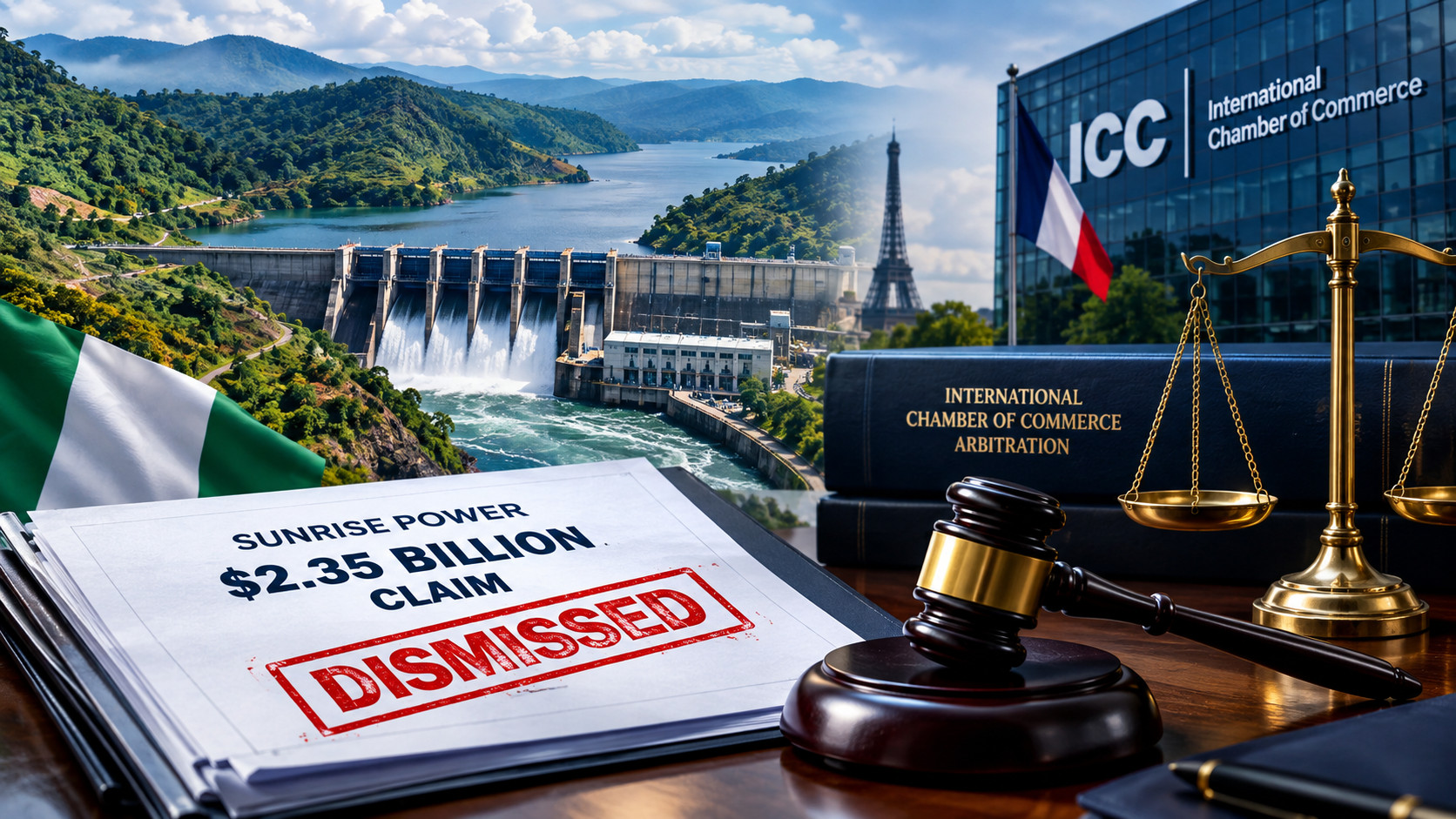
Nigeria has won a major international arbitration case against Sunrise Power over the long-running dispute surrounding the Mambilla Hydropower Project.
The International Chamber of Commerce (ICC) in Paris ruled in favour of Nigeria, rejecting Sunrise Power’s demand for $2.35 billion in compensation from the Nigerian government. The tribunal also ordered Sunrise Power and its promoter, Leno Adesanya, to refund Nigeria $11.8 million in legal costs.
The dispute dates back to 2003, when Sunrise Power claimed it had been awarded a contract worth about $6 billion to build, operate and eventually transfer the Mambilla hydropower project in Taraba State.
Sunrise later accused the Nigerian government of breaching its contractual obligations and took the matter to international arbitration, seeking billions of dollars in compensation.
Nigeria, however, disputed the validity and obligations arising from the alleged contract and subsequent agreements.
The case eventually became a long-running legal battle involving different administrations. Former Presidents Olusegun Obasanjo and Muhammadu Buhari also gave evidence during the proceedings, with Obasanjo maintaining that the original contract had not received the necessary approval.
The three-member tribunal rejected Sunrise Power’s claim that Nigeria had breached its obligations under the settlement agreement and its addendum.
It also rejected Sunrise’s demand for $400 million, which it said represented a $200 million settlement sum and another $200 million default payment.
The tribunal further ruled that Leno Adesanya, the promoter of Sunrise Power, was bound by the arbitration agreement and that it had jurisdiction over Nigeria’s counterclaim against him and his company.
Nigeria was facing a potential $2.35 billion compensation claim over the Mambilla project.
The ICC ruling means that claim has been rejected, while Sunrise Power has instead been ordered to pay Nigeria’s legal costs of $11.8 million.
The ruling therefore removes the immediate $2.35 billion compensation claim that had been hanging over the Federal Government in relation to the dispute.
The Mambilla Hydropower Project itself remains a separate issue. The project, planned to generate about 3,050 megawatts of electricity, has faced years of contractual, financing and other challenges.
The tribunal didn’t just reject Sunrise’s claim, it put an exact figure on what Nigeria gets back. Of the $11.82 million owed, $2.5 million comes straight out of an existing escrow account, with the remaining $9.3 million due directly from Sunrise and Adesanya, plus 10 percent annual interest until it’s paid. Arbitration costs were split too, with Sunrise and Adesanya carrying 75 percent of the bill and Nigeria covering the rest.
Get instant alerts and updates based on your interests. Be the first to know when big stories happen.
This wasn’t Sunrise’s only shot at Nigeria’s treasury either. A second, related arbitration saw the company chase $680 million in settlement and interest, tied to yet another claim worth more than $2.7 billion over the same project. Both efforts collapsed under the same tribunal’s scrutiny.
Nigeria’s legal defence had a bench of familiar names behind it. Attorney-General Lateef Fagbemi led the charge, with lawyers Elizabeth Oger-Gross and Tolu Obamuroh, now of Paul Hastings LLP, handling the courtroom battle in Paris. President Bola Tinubu singled both out by name in his response to the ruling.
Tinubu didn’t hold back either. He called the award a rebuke to what he described as predatory and exploitative claims by corrupt local and international entities and their enablers, framing the win as vindication after a legal cloud that had hovered over Mambilla for more than 20 years.
The project’s power output figure has shifted across reporting too, some accounts citing 3,050 megawatts, others 3,960. What hasn’t shifted is the scale of what’s at stake: a hydropower plant that could meaningfully reshape Nigeria’s chronically strained electricity grid, if financing and construction can finally move past the legal battles that have defined it since 2003.
For now, Abuja gets to focus on building the dam instead of defending against it.