
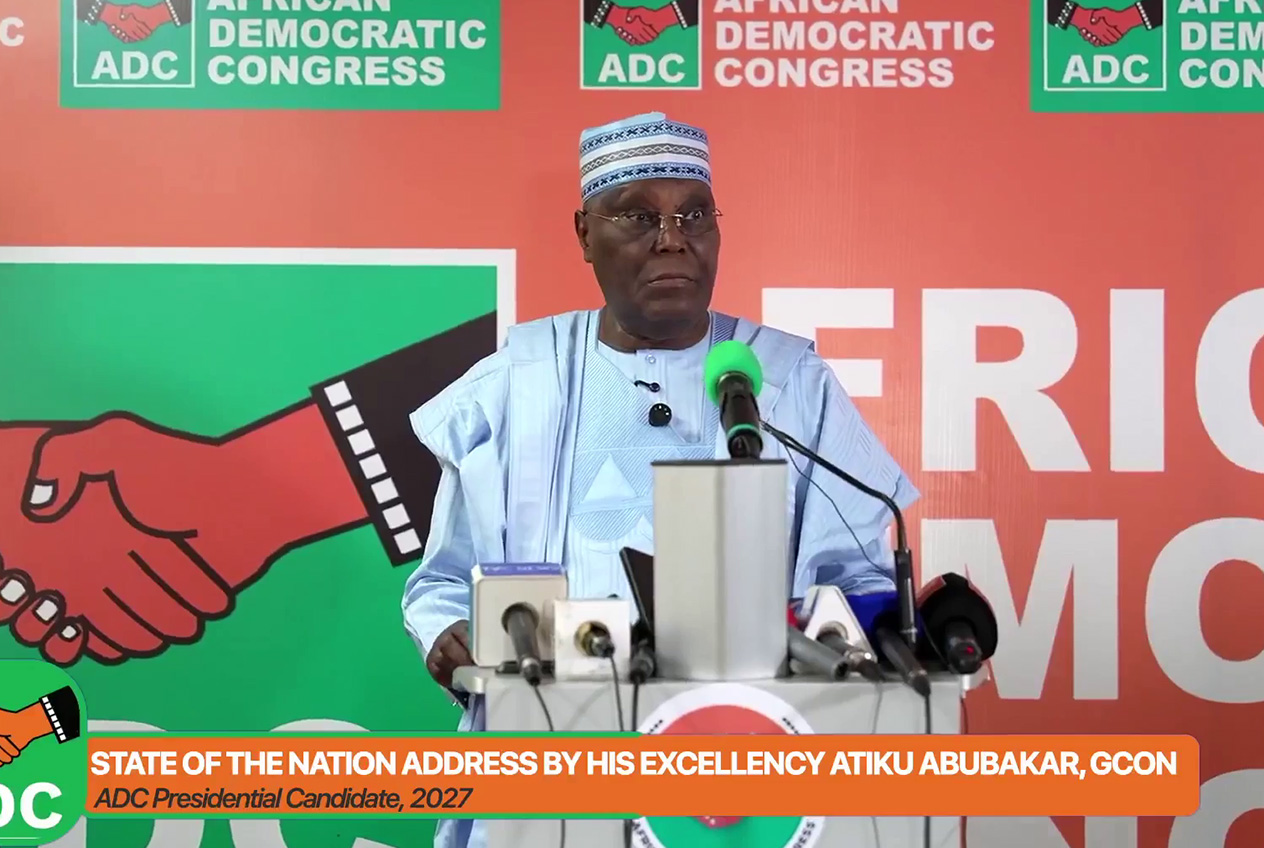
“Bola, where is this prosperity?”
That’s the question Atiku Abubakar put directly to President Bola Tinubu on Independence Day, and he didn’t soften it with diplomatic language. Speaking in his State of the Nation address on Thursday, the ADC presidential candidate challenged Tinubu’s prosperity claim by citing soaring food and fuel costs, insecurity, and unpaid debts.
The timing wasn’t accidental. Tinubu had just marked Nigeria’s 66th year of independence by declaring the country had moved past emergency treatment into what he called an age of prosperity. Atiku’s response arrived within hours, and it came with numbers attached.
Eggs. Bread. The things that sit on a Nigerian table every single day.
Atiku pointed out that the average price of an egg climbed from roughly ₦88 in April 2023 to about ₦261 by May 2026. That’s not inflation creeping. That’s a near tripling of cost for one of the cheapest protein sources Nigerian households rely on. He didn’t stop at eggs either. A sliced loaf of bread that cost around ₦500 in April 2023 had risen to roughly ₦2,000 for a smaller loaf by May 2026.
Smaller loaf. Higher price. Sit with that for a second.
The former vice president framed the entire picture in blunt, physical terms rather than economic jargon. He accused Tinubu’s administration of making it harder for Nigerians to eat, learn, seek treatment, and stay alive. Not harder to prosper. Not harder to save. Harder to survive the basics.
Atiku didn’t limit the criticism to prices alone. He used Tinubu’s own medical metaphor against him. Tinubu had described Nigeria as a cancer patient undergoing treatment, and Atiku turned that framing on its head, asking why the government now has more money while ordinary people can afford less. His line landed sharp: a patient who cannot afford to live is not proof that the treatment is working.
That’s the core of his argument. Government revenue climbing while household purchasing power collapses isn’t recovery. It’s a widening gap dressed up as progress.
He went further on fuel. Minimum wage numbers look better on paper, Atiku argued, but the real test is what that money actually buys. He noted that while minimum wage had increased in naira terms, the quantity of petrol workers could afford had dropped sharply. A bigger number in your pocket means nothing if it buys you less at the pump than it did three years ago.
Tinubu, to his credit, didn’t dodge the hardship question entirely in his own address. The president acknowledged that millions of citizens cannot wait for tomorrow, admitting that some Nigerian families still struggle for their next meal, next school fee, or next medical bill. He argued the suffering predates his administration, rooted in decades of low productivity and weak infrastructure rather than his reforms alone. He said the country cannot erase in four years what accumulated over generations, but insisted the course can change.
Atiku wasn’t moved by that framing. He reminded Tinubu that his own party had governed Nigeria for eight years before 2023, rejecting the idea that today’s leadership inherited the crisis from elsewhere.
Get instant alerts and updates based on your interests. Be the first to know when big stories happen.
Behind the rhetoric sits a debt figure that’s hard to spin either way. Nigeria’s recorded public debt stood at ₦166.79 trillion as of June 30, 2026, according to the Debt Management Office. Atiku tied that number directly to the affordability question, arguing that government celebrates macroeconomic indicators while millions of citizens struggle to translate those statistics into food on the table.
He didn’t stop at criticism. Atiku demanded something specific: an apology, directed at families who can no longer afford decent meals, workers whose wages vanish on transport before the month is halfway done, and pensioners watching inflation eat their fixed incomes alive.
Whether that apology comes is beside the point politically. The real battle here is over which numbers Nigerians believe heading into 2027, the government’s inflation charts, or the price tag on a loaf of bread at their local market.
Atiku’s closing line cuts straight through the noise: the true test of economic policy isn’t a growth chart. It’s whether Nigerians can afford food, transportation, housing, education, healthcare, and electricity.