
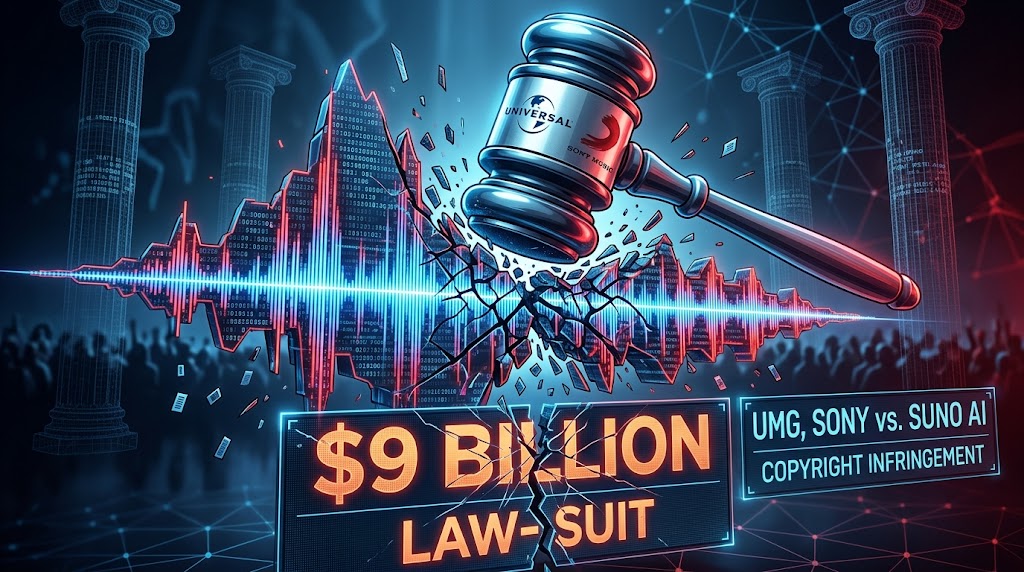
Universal Music Group and Sony Music have dragged Suno back to court, and this time the bill could run past $9 billion.
The two labels sued the AI music company for the second time on September 18, 2026, in the same Boston federal court that is already hearing their first case. The new complaint is blunt. It argues that Suno’s latest V6 model, sold to the public as a clean break, is “fruit from the same poisoned tree.”
The numbers explain the fear. US law allows up to $150,000 per willfully infringed work, so 60,202 recordings put the ceiling at just over $9 billion. Do the maths. That is more than Suno is worth.
The judge pointed to the door
This fight did not start last month. The dispute dates back to 2024, when UMG, Sony and Warner sued Suno over its training practices. Warner later settled and struck a licensing agreement with Suno, while UMG and Sony stayed in the ring.
That first case covered a tiny slice of the labels’ catalogue. The original complaint asserted just 560 works, which capped exposure at a few tens of millions of dollars. Then the labels came back with a much bigger list. They asked to add more than 61,000 further works, which a forensic analysis of Suno’s training data had turned up.
Suno fought it and won, sort of. On 18 August the court denied the request without prejudice, mainly because amending would disturb the case schedule. It did not question the claims themselves, and concluded that parallel cases best balanced the labels’ interests with judicial economy.
So the labels filed a parallel case. Simple.
Suno’s own words, used against it
The new filing leans hard on things Suno has already said. According to the complaint, Suno acknowledged in the first case that it built its models by feeding the program tens of millions of recordings, which presumably included the plaintiffs’ music. What it would not do, the labels claim, is name them.
Then there is Suno’s licensing spree. Warner signed in November 2025. BMG followed on 12 August, and Believe signed on 8 September to supply training data. Nine days later Suno launched V6 on licensed catalogue. For the labels, three deals in under a year prove a working market for AI training licences exists. Suno, in their telling, just chose not to pay into it.
The complaint even turns Suno’s user contract into evidence. Since January 2024, Suno’s terms of service have required every user to grant the company a worldwide, irrevocable licence over anything they upload. If Suno demands permission from its own users, the argument goes, it knew it needed permission from the labels too. That is the path to proving the infringement was knowing and willful, which is what unlocks the higher damages tier.
It gets uglier. The labels allege Suno “stream ripped” audio from YouTube using code to extract and download files in breach of YouTube’s terms, and they are seeking up to $2,500 for each act of circumvention on top of the per-song damages. They also quote an early investor who said Suno “needed to make this product without the constraints” of label deals.
Suno says V6 is clean
Suno is not blinking. Its chief product officer Jack Brody has said V6 was trained entirely from scratch on different data and without UMG or Sony recordings. The company also dismissed the lawsuit as “fundamentally flawed on both the facts and the law.”
The labels have an answer for that. They argue V6 learned from songs users made with older Suno models, and from users’ choices between the two versions Suno generates for every prompt. In other words: if the old model was built on their music, everything it produced carries that DNA, and V6 drank from that well.
Suno also has the fair use card. In opposing the labels, it pointed to two rulings that found AI training to be transformative. That legal question is still wide open in American courts.
Get instant alerts and updates based on your interests. Be the first to know when big stories happen.
Bigger company, bigger target
Suno has grown fast since the first lawsuit landed. Its latest round raised more than $400 million at a $5.4 billion valuation, up from $2.45 billion in autumn 2025. The labels say it makes hundreds of millions a year and projects $1 billion in revenue by 2028.
The flood of machine-made music is part of the labels’ case. Deezer reported in July that AI tracks passed half of all daily uploads for the first time, roughly 90,000 a day. For African artists already fighting for playlist space against global catalogues, that figure is not abstract. Every AI track is another competitor for the same listener’s ear, and the same royalty pool.
Sony has run this playbook before. It filed a second lawsuit against Udio on July 20 with the 30,117 recordings a judge had kept out of its first case. And Europe has already drawn blood: a German court found Suno broke copyright in a case brought by the collecting society GEMA.
The industry reading is obvious. A $9 billion threat is less about winning at trial than forcing a cheque. Observers note the labels presumably hope the mere threat of multi-billion dollar damages pushes Suno and Udio into signing deals with all three majors.
Warner already signed. Universal and Sony are still waiting, and they have just raised the price.