
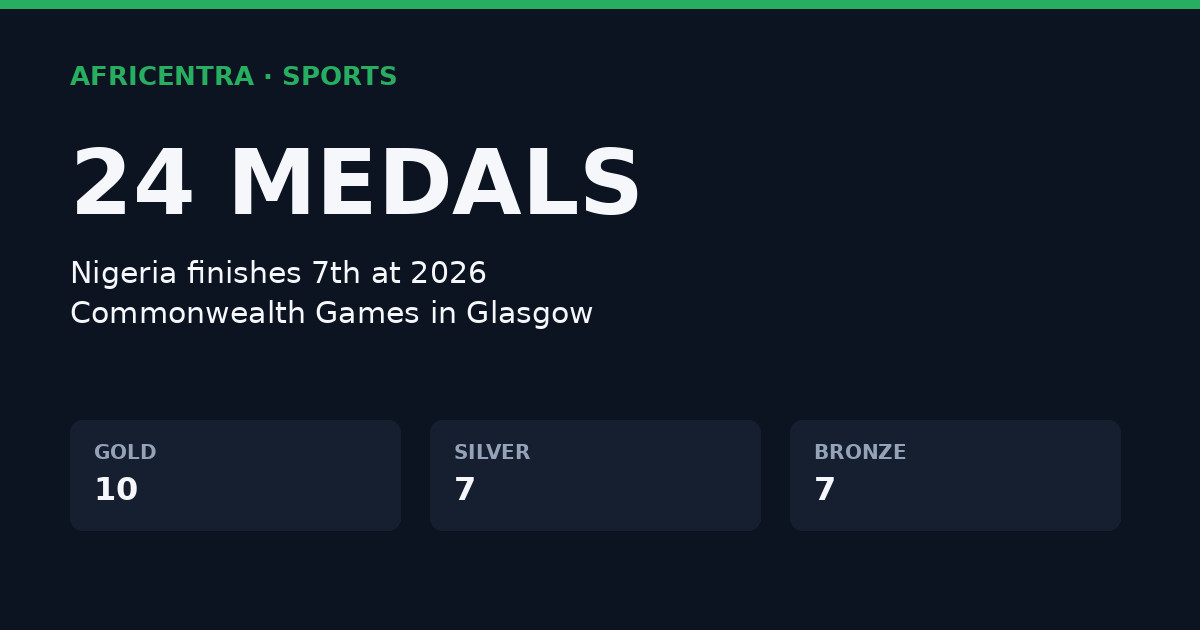
Team Nigeria closed out the 2026 Commonwealth Games in Glasgow with its best outing among African nations, finishing 7th overall on the medal table with 24 medals: 10 gold, 7 silver and 7 bronze.
Athletics carried much of the haul. Samuel Ogazi won gold in the men’s 400m, Ezekiel Nathaniel took the men’s 400m hurdles, Chukwuebuka Enekwechi topped the men’s shot put, and Goodness Nwachukwu won the women’s discus throw in the F42-44/61-64 category. Weightlifting added three more golds through Rafiatu Lawal, Onome Didih and Edidiong Umuofia, while para powerlifting contributed golds from Folashade Oluwafemiayo, Esther Nworgu and Riluwan Idris.
Silver went to Jessica Oji in the women’s shot put, Ruth Usoro in the long jump, and Udodi Onwuzurike in the men’s 200m, alongside three more from para powerlifting and weightlifting. On the bronze side, Tobi Amusan added to her collection with a finish in the women’s 100m hurdles, Kayinsola Ajayi took bronze in the men’s 100m, and Temitope Adeshina’s high jump bronze marked Nigeria’s first medal in the event in more than 70 years. The men’s 4x100m relay team of Favour Ashe, Ajayi, Nicholas Fakorede and Onwuzurike also picked up bronze, after an initial silver placing was downgraded on review.
I keep coming back to that high jump bronze. Seventy years is a long stretch for a single event to go without a Nigerian medal at this level, and Adeshina closing that gap says as much about depth building behind the household names as any of the golds do.
The 2026 Games fielded roughly 3,000 athletes competing for 215 gold medals in Glasgow, a smaller field than the 2022 Birmingham edition, which drew more than 5,000 competitors across 280 medal events. Australia topped the table with 171 total medals, 70 of them gold, a scale that puts Nigeria’s 24-medal haul in perspective even as it topped the African standings.
What stands out is the spread. This was not a team riding one or two star performances. Athletics, weightlifting, para powerlifting and judo all produced medals, and the roster mixed established names like Amusan with athletes making their first senior Commonwealth Games appearance. That kind of breadth tends to matter more over a four-year cycle than any single Games result.
Get instant alerts and updates based on your interests. Be the first to know when big stories happen.
Nigeria’s sports authorities have not yet detailed what comes next for the athletes and coaches involved, but a 24-medal finish, the country’s best relative showing among African teams at these Games, gives selectors a wide pool to draw from heading toward the next major continental and global competitions.