
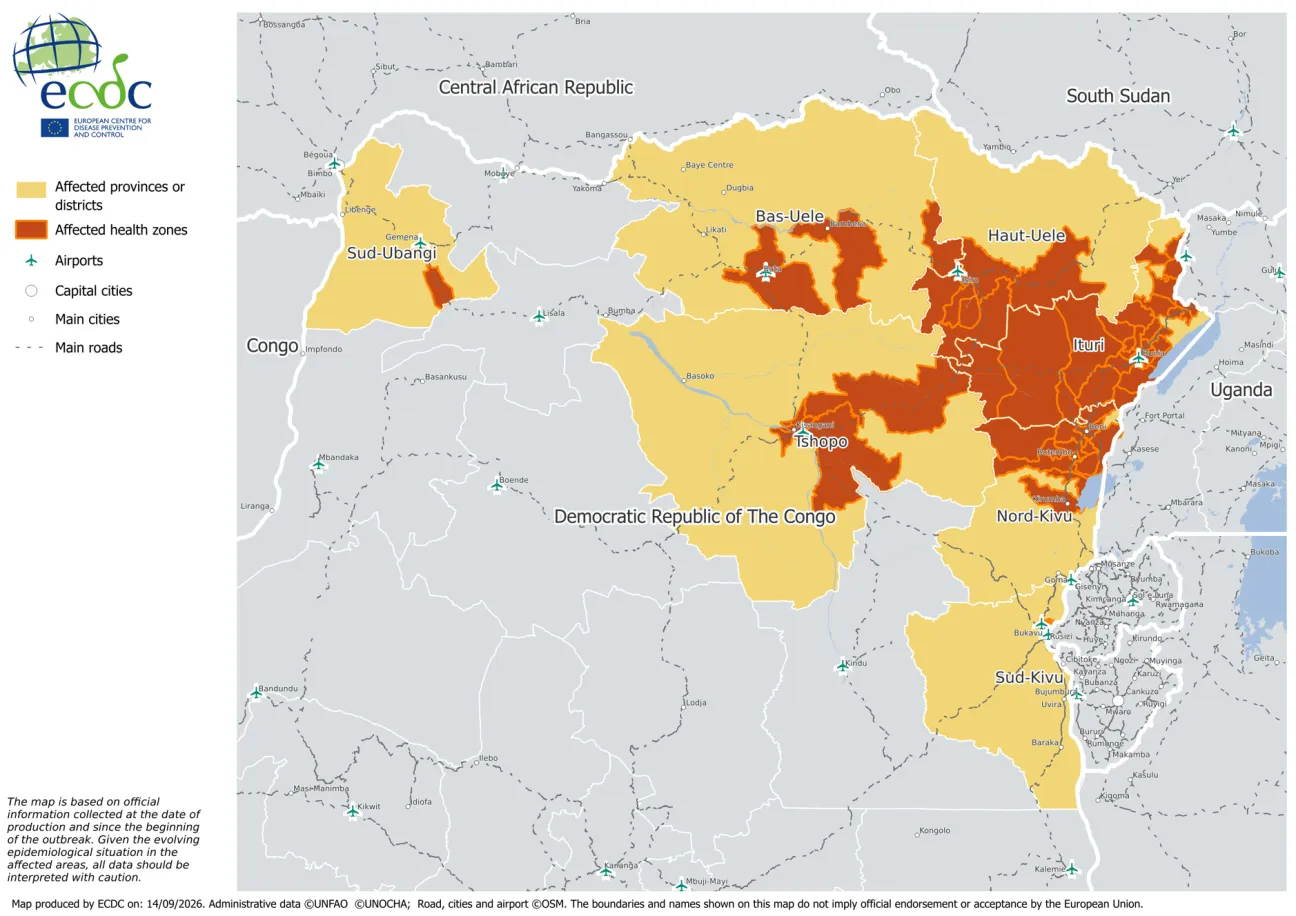
Africa’s top public health body has warned that the Ebola outbreak in the Democratic Republic of Congo is spreading rapidly beyond its original epicenter in Ituri Province, with new clusters now emerging in North Kivu and Haut-Uele.
Africa CDC said on September 11 that the outbreak, first declared in May 2026, has infected 6,843 people and killed 3,310, with more than 5,400 cases concentrated in Ituri alone. North Kivu has recorded over 1,000 cases since May, including 381 new infections in its latest three-week reporting period, more than double the count from the period before.
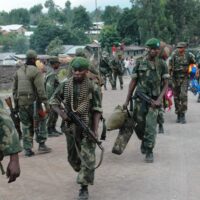
Yap Boum, Africa CDC’s head of emergency preparedness and response, said the accelerating spread is being driven by insecurity, mass displacement, health-worker strikes and the ongoing conflict between government forces and M23 rebels in the country’s east.
Complicating the response, the outbreak is caused by the Bundibugyo strain of Ebola, against which the 70,000 vaccine doses already delivered offer no protection, since they target the more common Zaire strain. Africa CDC’s Placide Mbala Kingebeni said vaccination trials have begun in Tshopo, Haut-Uele and Bas-Uele provinces, with vaccination in Ituri set to begin the following week.
What makes this outbreak different is the trajectory, not just the toll. Case counts and deaths have actually started to ease in Ituri, the province where the virus first took hold. But that improvement is being cancelled out by what’s happening next door, where North Kivu and Haut-Uele are now absorbing the outbreak’s momentum instead.
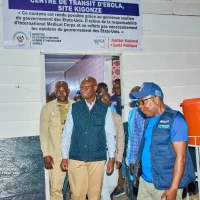
Displacement sites sit at the center of the danger. Residents crowded into these camps already live under extremely precarious conditions, and that crowding is exactly what gives Ebola room to move fast between people who have nowhere else to go.
Goma adds another layer of difficulty. The provincial capital of North Kivu remains under the control of Rwanda-backed M23 rebels, and the fighting between those forces and the Congolese government has directly complicated efforts to reach affected communities, deliver care, and track the virus as it spreads into new health zones.
The comparison public health officials are now drawing is a grim one. The World Health Organization has said this outbreak remains out of control and is on track to overtake the 2014-2016 West Africa epidemic, the deadliest Ebola outbreak ever recorded, which killed more than 11,000 people across Guinea, Liberia, and Sierra Leone.
Get instant alerts and updates based on your interests. Be the first to know when big stories happen.
On vaccines, timing matters as much as supply. Congo began vaccinating health workers and other front-line responders last month using the Ervebo vaccine, the shot that proved effective in past outbreaks caused by the Zaire strain. But this outbreak isn’t Zaire. It’s Bundibugyo, a distinct variant with no licensed vaccine of its own yet, which is why the current trials matter so much.
Kingebeni said the strategy behind those trials is deliberate. Rather than starting in Ituri, where the outbreak has already run longest, the campaign is targeting newly affected provinces first, in an effort to box the virus in before it spreads any further. Ituri’s own vaccination rollout will follow next week.
Even that plan runs into a hard ceiling. Kingebeni pointed to the limited number of doses on hand as one of the biggest constraints facing the response, a reminder that having a scientific answer and having enough of it to deploy at scale are two very different problems.