
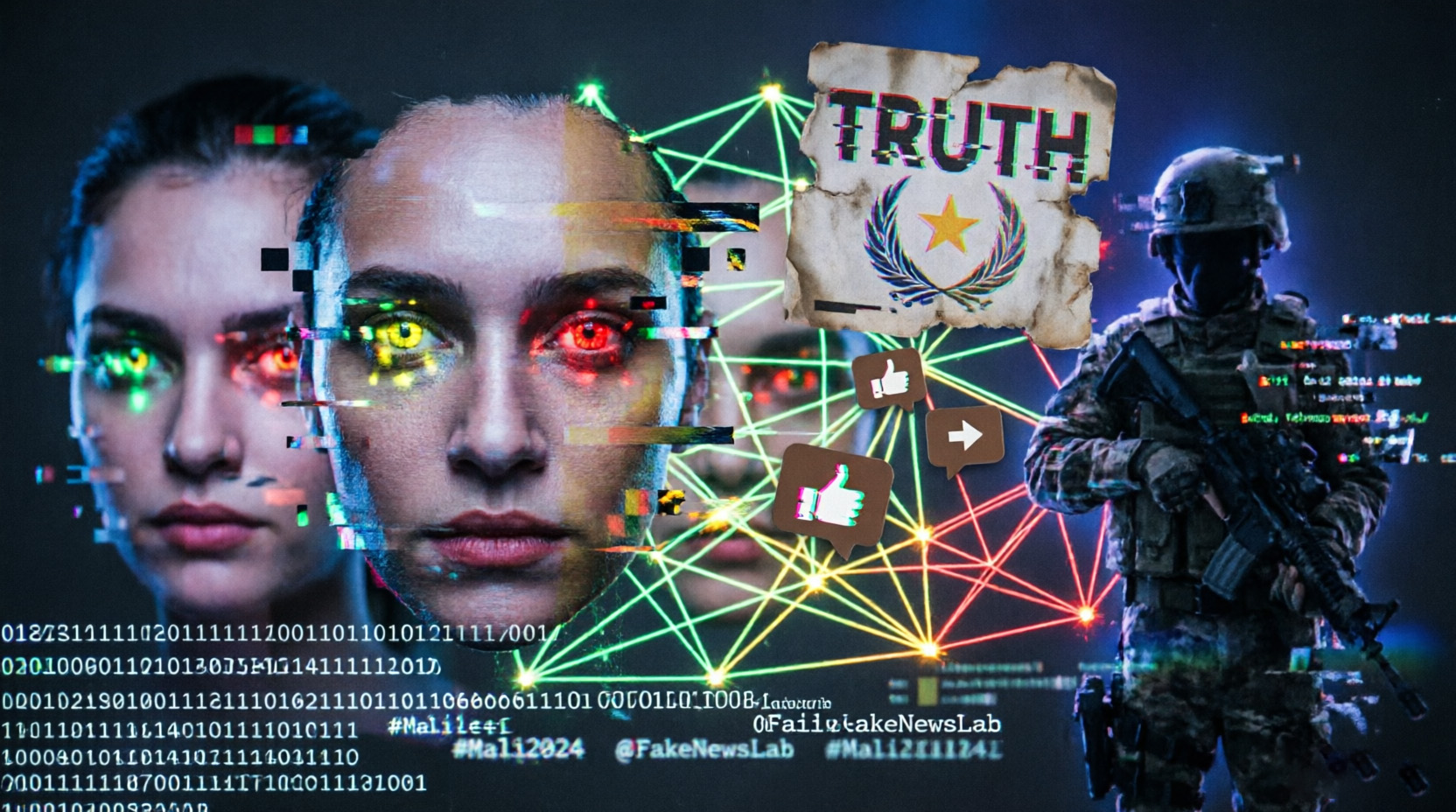
DAKAR: Artificial intelligence is becoming a new weapon in Mali’s long-running conflict, with jihadists, separatists and Russian-backed information networks using increasingly sophisticated tools to manufacture propaganda and shape public opinion, according to a new report.
The report, “Algorithms at War: How Generative AI Is Reshaping the Malian Conflict,” was published this week by Senegal’s Timbuktu Institute, a Dakar-based research centre affiliated with Gaston Berger University.
Researchers found that jihadist group JNIM has used relatively basic AI-generated propaganda posters, including material promoting videos from an April 25 attack. Separatist FLA networks, meanwhile, have gone further, creating “Azzghim,” an entirely fictional Tuareg fighter persona built to spread narratives online.
Its findings offer a glimpse into how quickly generative AI is moving from a consumer technology into the information battles surrounding one of West Africa’s most unstable conflicts.
The Timbuktu Institute warned that the technology’s use could escalate beyond propaganda, potentially evolving into AI-assisted military targeting and highly personalized recruitment content tailored to individual social media users.
The technology is not being used in the same way by every actor.
Some groups are producing relatively crude AI-generated images.
Others are creating entirely fictional people who appear to exist online.
And Russian information networks, according to the researchers, are deploying AI alongside an already established disinformation infrastructure capable of reaching millions of people.
“Generative artificial intelligence is becoming a new front in this information war in Mali,” Bakary Sambe, director of the Timbuktu Institute, told RFI.
From Propaganda Posters to Imaginary Fighters
The report examines the use of generative AI by several actors involved in Mali’s conflict, including the al-Qaida-linked Jama’at Nusrat al-Islam wal-Muslimin (JNIM), the Tuareg-led Front de libération de l’Azawad (FLA), Mali’s transitional authorities and Russia’s Africa Corps.
JNIM appears to be at the more basic end of the spectrum.
Researchers identified AI-generated propaganda images circulated by the group’s media arm, Az-Zallaqa, including material promoting videos linked to attacks carried out in April 2026.
The images contain visual clues that suggest they were generated artificially, including distorted buildings and vegetation, excessive smoothing and other inconsistencies.
For now, the institute describes JNIM’s use of the technology as relatively limited.
But the FLA’s use is more sophisticated.
Researchers identified “Azzghim”, a fictional Tuareg fighter created entirely through artificial intelligence and presented online as a real person.
The character appears in videos making statements critical of the Africa Corps and supportive of the Azawad independence cause.
The institute said an examination of the videos revealed telltale signs of artificial generation, including unusual body movements, pixel abnormalities, inconsistent colouring and problems with the audio.
There is, crucially, no real fighter behind the persona.
Azzghim does not exist.
The Question Many Africans Are Asking is: Why Create a Fighter Who Isn’t Real?
The answer is more significant than it may initially appear.
A fictional character gives an armed movement something that a conventional propaganda statement cannot easily provide: a recognisable human face.
The character can be given a particular age, appearance and personality.
Messages can then be adapted to different audiences.
The Timbuktu Institute said the Azzghim persona could help the FLA make its messaging more accessible to young audiences while reinforcing narratives around the Azawad independence movement.
There is another advantage.
A fictional fighter cannot be arrested.
He cannot be identified.
He cannot be interrogated.
He cannot contradict the organisation.
And he can be made to say exactly what his creators want him to say.
Researchers also identified a network of TikTok accounts repeatedly reposting and remixing Azzghim material, creating the appearance of a much larger grassroots following.
One account identified by the institute had more than 200,000 followers.
That distinction matters in the modern information war.
The objective is not necessarily to persuade everyone.
It can be enough to make a narrative appear popular.
Russia’s Information Machine Is Operating on Another Scale
The most extensive use of AI identified in the report is associated with Russia’s Africa Corps, the force that followed the Wagner group’s role in parts of Africa.
Here, the technology is being added to an existing and much larger information operation.
Researchers documented the use of fabricated videos, deepfakes and AI-generated social media comments in campaigns supporting Russia’s position and attacking Western influence.
Sambe described the evolution as a move from a relatively small-scale operation to something approaching industrial production.
The Timbuktu Institute said researchers counted 19 Russian disinformation campaigns targeting Mali, Burkina Faso and Niger since 2018.
Some of the material identified in the research attracted almost five million views.
The campaigns promoted narratives portraying Malian military forces and their Russian allies as successful against jihadist and separatist groups while attacking France, the Economic Community of West African States, or ECOWAS, and human rights organisations.
The broader figure is consistent with earlier research from the Africa Center for Strategic Studies, which identified 19 Russian disinformation campaigns directed at Mali, Burkina Faso and Niger since 2018.
But there is an important distinction.
The existence of those 19 campaigns predates the current explosion in generative AI.
The new development identified by the Timbuktu Institute is how AI can make such operations faster, cheaper and potentially more difficult to attribute.
The Battlefield Is No Longer Just on the Ground
Mali’s conflict has already gone through several transformations.
Jihadist groups have fought the state for more than a decade.
The country’s military governments have broken with traditional Western partners.
France has withdrawn its forces.
Russian security personnel have become increasingly prominent.
And Mali, Burkina Faso and Niger have moved away from ECOWAS while building their own regional alliance.
Now the contest is increasingly taking place online.
That means an operation no longer needs to end when the shooting stops.
A military setback can be reframed as a victory.
An enemy can be portrayed as defeated when it is not.
A fictional soldier can be presented as evidence of popular support.
And a video that never happened can be viewed by millions before anyone has established that it is fake.
This is where generative AI changes the calculation.
The Real Danger May Be What Comes Next
The Timbuktu Institute’s warning goes beyond fake photographs and fabricated videos.
Researchers believe the technology could eventually be used for highly personalised recruitment campaigns, with messages tailored to particular audiences or individuals.
That raises a particularly difficult problem for counter-terrorism agencies.
Traditional propaganda broadcasts the same message to thousands of people.
AI can potentially produce thousands of different messages.
A young person interested in religion could receive one type of material.
Someone angry about unemployment could receive another.
A person hostile to a foreign government could be targeted with another.
The technology could potentially make propaganda more personal, more convincing and more difficult to detect.
And that could change recruitment itself.
And There is Also – The Military Dimension
The report also raises a more serious possibility: the eventual use of AI beyond information warfare and into military operations.
The institute warns that developments could potentially move towards AI-assisted targeting, although this remains a future risk rather than an established feature of the activities documented in the report.
That distinction is important.
There is already evidence of AI-generated propaganda and fabricated online identities.
There is not equivalent evidence presented in the report that the groups examined are currently using generative AI to conduct autonomous military targeting.
But the possibility illustrates why researchers are paying attention now.
The technology available to an ordinary internet user today is becoming dramatically more capable.
The same tools that can generate a convincing fictional face can be adapted for increasingly sophisticated forms of manipulation.
For researchers, Mali offers an unusually revealing case study because several different forms of information warfare are operating at the same time.
There are jihadist groups attempting to recruit and project strength.
There are separatists trying to build support for an independence movement.
Get instant alerts and updates based on your interests. Be the first to know when big stories happen.
There are military authorities seeking to control the national narrative.
And there are foreign actors attempting to influence perceptions of Russia, France, the West and regional organisations.
Generative AI gives each of them another tool.
But their capabilities differ sharply.
JNIM is experimenting.
The FLA is building fictional identities.
Russia’s Africa Corps has access to a much larger information infrastructure.
That uneven adoption is itself significant.
The AI revolution in information warfare is unlikely to arrive everywhere at once.
Instead, the most sophisticated actors are likely to use increasingly advanced tools while less-resourced groups adopt simpler applications.
The implications extend well beyond Mali’s borders.
The Sahel has become one of the world’s most contested information environments.
Russia has invested heavily in influence operations across the region, while militant organisations and domestic political actors have developed their own propaganda networks.
Earlier research found that West Africa accounted for almost 40% of documented disinformation campaigns in Africa, with roughly half linked to Russia.
The concern now is that generative AI could dramatically lower the cost of producing convincing false content.
A sophisticated propaganda operation once required graphic designers, video editors, translators, actors and distribution networks.
Some of those functions can now be automated.
That does not mean AI replaces the people running such campaigns.
It means the people behind them can potentially produce far more material, in far less time.
The New Problem for Journalists and Fact-Checkers
For journalists, the challenge is becoming equally serious.
It was once possible to ask whether a photograph was genuine.
Now the question is whether the person in the photograph ever existed.
A video may show a soldier making a statement that he never made.
An audio recording may sound authentic but be artificially generated.
A social-media account may appear to have thousands of supporters while much of its content is being amplified by coordinated networks.
And by the time a fact-checker has disproved one piece of content, dozens more may already have appeared.
This creates an uncomfortable asymmetry.
Producing false information can take seconds. Proving that it is false can take hours or days.
Why The Information War Is Becoming Harder to See
That may ultimately be the most important finding of the Timbuktu Institute’s research.
The next phase of Mali’s conflict may not always look like propaganda.
It may look like an ordinary TikTok video.
An apparently authentic interview.
A photograph of a fighter.
A comment beneath a news story.
A video claiming to show a military victory.
Or a young person explaining why he believes one side of the conflict is right.
The content may be entirely synthetic.
But the emotions it generates can be completely real.
And that is precisely why the institute is warning that the boundary between reality and fabrication is becoming increasingly difficult to identify.
Mali’s conflict is therefore acquiring another battlefield.
It is not a battlefield of tanks, rifles and drones.
It is a battlefield of images, identities, algorithms and attention.
And unlike the physical frontlines, this one can reach millions of people without crossing a single border.