
Picture this: you are stuck in the familiar crawl of Lekki-Epe Expressway traffic near the toll plaza, phone in hand, scrolling past another listing for a ₦500 million duplex. To your left, the glass towers of Landmark Beach glitter. A little further down, joggers spill onto Elegushi Beach at sunset. It feels brand new like money invented this place yesterday.
It didn’t. Beneath every square meter of this concrete jungle sits roughly 400 years of history: fishing settlements that became sovereign land- holding kingdoms, a brutal demolition that tried to erase a community, and a legal comeback that turned tragedy into some of the most valuable real estate in West Africa. If you live here, plan to invest here, or you’re studying property law, understanding the Oniru (Iru) Kingdom and the Ikate-Elegushi Kingdom isn’t optional trivia, it is the foundation everything else is built on, literally. If you are an investor or prospective homebuyer seeking to conduct thorough due diligence before committing capital to these two historic kingdoms, this article was researched and written specifically for you.
Prepare Your Mind to Understand Over 400 Years in the Making
To understand Lagos land, you first need to understand the Idejo, the White-Cap Chiefs. Think of them as the original title-holders of Lagos: a class of hereditary chiefs recognized as the true, aboriginal owners of the land, tracing their authority back to Olofin Atekoye, the legendary founding figure of Lagos settlement. Every major land-owning family on Lagos’s coastline including Oniru and Elegushi draws its legitimacy from this Idejo lineage.
The Iru Clan, ancestors of today’s Oniru Kingdom, trace their founding to around 1589, with Chief Onigefon as the first recognized monarch. Further along the coast, the Ikate Clan precursor to today’s Ikate-Elegushi Kingdom was established around 1606, led by Kusenla. Both began the same way: small fishing and farming settlements strung along a marshy Atlantic coastline, governed by chiefs rather than crowned kings. Over centuries, as Lagos grew from colonial outpost to Nigeria’s commercial capital, these chieftaincies formalized into full monarchies, a transformation that set the stage for the high-value estates you see today.
The Thrones and Their Modern Guardians
Succession works differently for each kingdom, and this matters if you’re ever trying to understand who actually has authority to sign off
on land. The Oniru stool rotates among three ruling houses, Abisogun, Akiogun, and Ogunyemi, meaning the throne moves between branches of the extended royal family rather than staying with one bloodline. The Elegushi stool, by contrast, descends through sub branches of a single foundational lineage, the Kusenla Ruling House.
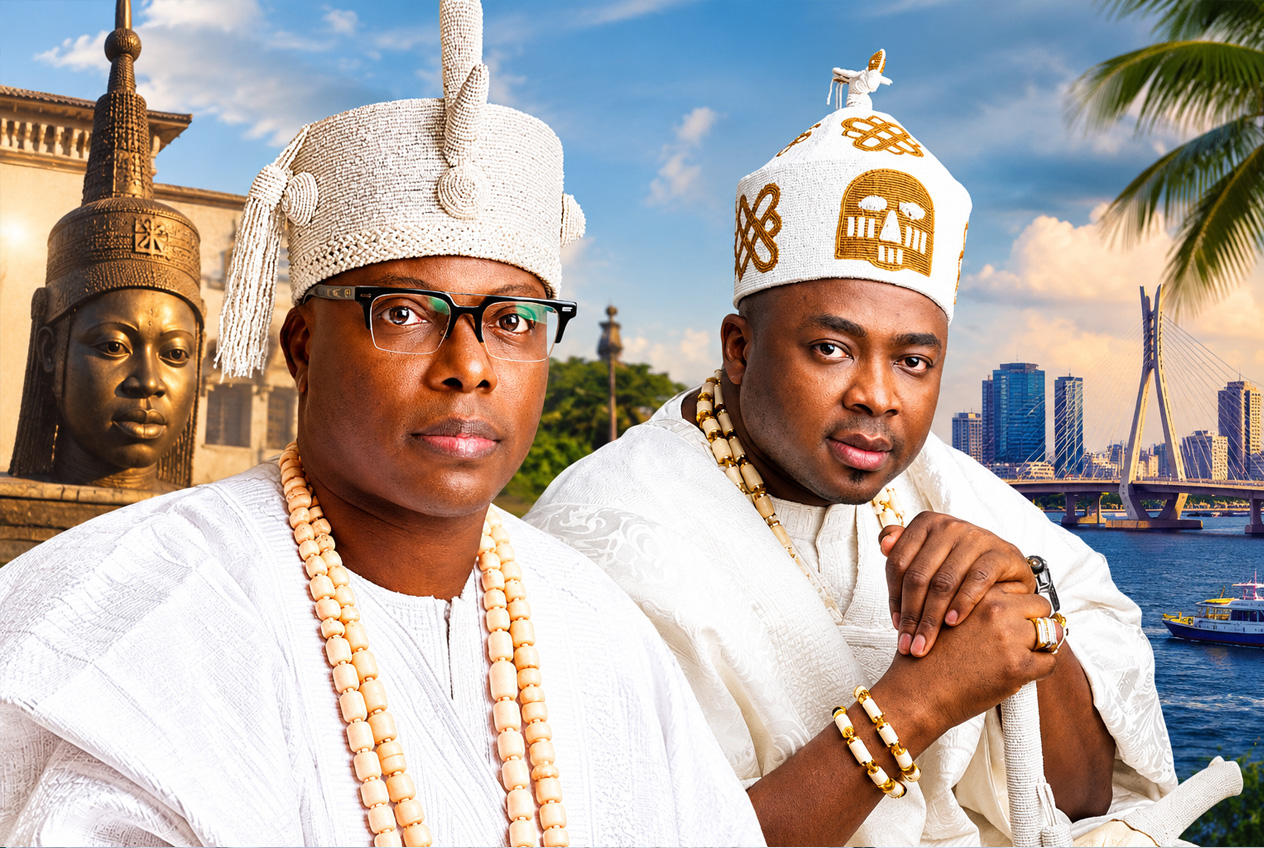
The current monarchs both bring corporate- world thinking to traditional rule. Oba Abdulwasiu Omogbolahan Lawal (Abisogun II) ascended the Oniru throne in June 2020, arriving with years of experience as a Lagos State government commissioner, public administration experience he now applies directly to managing Iru’s land and infrastructure. Just up the coast, Oba Saheed Ademola Elegushi (Kusenla III) has led Ikate- Elegushi since April 2010, taking the throne at just 34 making him one of the youngest
reigning monarchs in Lagos State armed with a master’s degree in economics. Both men run their kingdoms less like ceremonial institutions and more like active real estate stewards, actively courting developers and investors.
The Ghost of Maroko – The Tragic Pivot to Wealth
Here’s the part of the story that doesn’t make it into glossy real estate brochures.
On July 14, 1990, under the orders of Military Governor Raji Rasaki, bulldozers moved into Maroko, a densely populated waterfront community on this same stretch of coastline and flattened it. An estimated 300,000 residents were displaced almost overnight, their homes destroyed in the name of “urban renewal” and flood control. Families were scattered to relocation sites including Ilasan, Jakande, and Ikota, many receiving little compensation for homes and livelihoods built over generations.
It is a genuinely painful chapter, and it shouldn’t be softened. But it’s also the hinge point of this story. In the years that followed, the royal families connected to this land, including the Oniru and Elegushi ruling houses fought
protracted legal battles to reclaim ancestral title to the demolished territory. They won, and rather than leaving the land vacant, they partnered with developers to rebuild it as premium residential and commercial real estate. The corridor that displaced 300,000 people in 1990 is now one of the most expensive stretches of land in West Africa. It’s a genuinely uncomfortable irony: catastrophe for one generation became capital for the next.
Where Does One End and the Other Begin? I also have asked this question within and amongst custodians in the two kingdoms and to be truthful and sincere, the answer is some-what narrow.
If you are standing at the Lekki Toll Plaza, you are essentially standing at a border crossing between two sovereign traditional territories, even though there’s no visible checkpoint.
Oniru territory covers the gateway zone running from the toll plaza area to roughly the popular 1st Roundabout (Known as Lekki Roundabout). This includes Oniru Estate itself, the British International School, and the Landmark Beach complex.
Ikate-Elegushi territory picks up from there, covering the peninsula stretch from the 1st Roundabout to the 3rd Roundabout, home to the Oba Elegushi Palace, Kusenla Road, and Elegushi Beach.
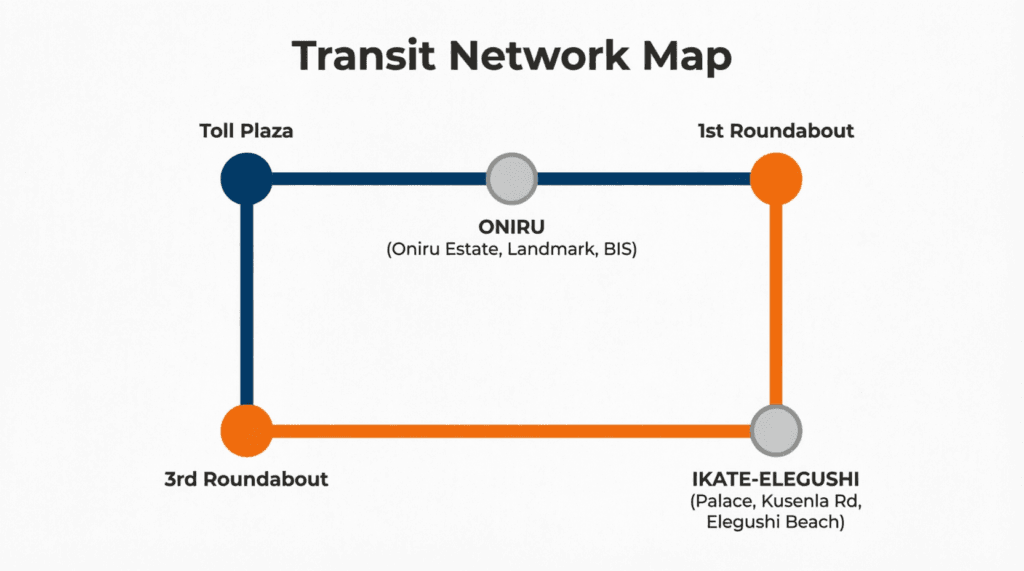
Knowing which side of that invisible line a plot sits on determines which royal family’s customary consent you will need and which zoning rules apply.
The High-Stakes Land Game – My Due Diligence for Investors
Prices tell the story of demand. As of recent market data, land in Oniru trades around ₦1,500,000 – ₦2,000,000 per square meter, while Ikate-Elegushi sits at ₦600,000 – ₦1,200,000 per square meter, still premium, but more accessible.
Now, the part every diaspora investor needs tattooed on their brain: an Oba’s blessing is not the same as legal title.
Nigerian land law operates on two tracks. Customary law is the traditional system, family and royal land rights passed down through lineage, recognised by the community but not automatically recognised by the state. Statutory law, governed by the Land Use Act of 1978, is what the government actually enforces it vests ultimate control of land in the state Governor and requires formal documentation to be legally secure.
This means a royal family or its agents can sell you land with full customary blessing, and you can still lose it if the paperwork is not “perfected” a term meaning the title has been fully registered and recognised by state authority. Perfection typically involves securing a 99-year leasehold, a Global Certificate of Occupancy (C of O), and formal Governor’s Consent to any transfer.
Before you sign anything, run this checklist:
Chart the land at the Surveyor-General’s office in Alausa to confirm exact boundaries and rule out overlapping claims.
Search the registry at the Lagos State Lands Bureau to verify there’s a clean chain of title with no competing encumbrances.
Get instant alerts and updates based on your interests. Be the first to know when big stories happen.
Verify signing authority on the Deed of Assignment — confirm the person signing actually has legal power to convey the specific parcel, not just general royal standing.
Confirm Governor’s Consent has been obtained or is obtainable for your transaction.
Skip any of these steps, and you are gambling, not investing. Believe me many have lost millions of dollars by not adhering to this precautions.
Every property owner here eventually meets the Land Use Charge (LUC) – Lagos State’s annual property tax. The formula:
| Component | Value |
| Assessed Market Value | Property-specific |
| Relief Rate | 40% relief (×0.6 multiplier) |
| Leased Residential Rate | 0.132% annually |
| Commercial Rate | 0.394% annually |
In order to understand the components above, Let me give you an simplified example. For an owner-occupied property assessed at ₦500,000,000, the LUC calculation would be: ₦500,000,000 × 0.6 × 0.0394% ≈ ₦118,200 per year.
Zoning is where the two kingdoms diverge sharply. Oniru permits high-density towers of 10 to 15+ floors, which is why Landmark and its neighbors reach skyward. Ikate-Elegushi caps residential builds at 5 floors (Ground + 4), or just 3 floors within its deeper private estates, a deliberate choice to preserve a lower-density, more residential character.
Both territories also enforce hard physical setbacks: 150 meters from the ocean’s high-water mark (protecting against erosion and storm surge), 15 meters from major canals, and 45 meters from the center line of the Lekki-Epe Expressway. These aren’t suggestions they are the difference between a property that survives due diligence and one that gets flagged for demolition later.
Let’s talk about what actually makes Oniru and Ikate-Elegushi so incredible. It is not just that they are old, it is how completely they have reinvented themselves. Picture this: back in the 1500s and 1600s, these were just humble fishing villages. But instead of fading away and becoming just a footnote in a history textbook, they adapted.
So, the next time you are grabbing a drink at Elegushi Beach, or maybe just sitting in bumper-to-bumper traffic at the Toll Plaza, I want you to look around and realize what you are actually experiencing. You aren’t just in a trendy real estate hotspot. You are literally walking through a living, breathing history book. Every single square meter of ground beneath your feet has a story, a chief who oversees it, and a chain of ownership stretching back over four centuries.