
Summary
I want you to think about your DStv or GOtv bill for a second.
Key Takeaways
- Their concern is technical but important: a satellite system does not fully replace analogue terrestrial broadcasting in the way a conventional digital switcho.
- If you already own a compatible decoder, FreeTV is close to the best deal in Nigerian television history.
- Let me take you through what FreeTV actually is, what it will cost you in practice, and whether it has any real chance of doing what its name suggests: ending.
- "With FreeTV, families across Nigeria can enjoy quality digital television without a monthly subscription, while our local content producers, technicians and y.
- The ₦1,500 figure you are seeing attached to FreeTV is what the NBC describes as the Digital Access Fee, a once-a-year charge, not a monthly subscription.
I want you to think about your DStv or GOtv bill for a second. Now I want you to compare it to ₦1,500 a year.
That is the pitch the Nigerian government has just put on the table. On Wednesday, June 17, 2026, the Federal Government officially launched FreeTV, a national digital television platform promising more than 100 channels with no monthly subscription fee. If that sounds too good to be true, stay with me, because the full story is more complicated, and more interesting, than the headline.
Let me take you through what FreeTV actually is, what it will cost you in practice, and whether it has any real chance of doing what its name suggests: ending Nigeria’s dependence on pay-TV giants like DStv.
The launch was part of Nigeria’s long-running Digital Switch-Over programme, and the government framed it as a direct extension of President Bola Tinubu’s Renewed Hope Agenda.
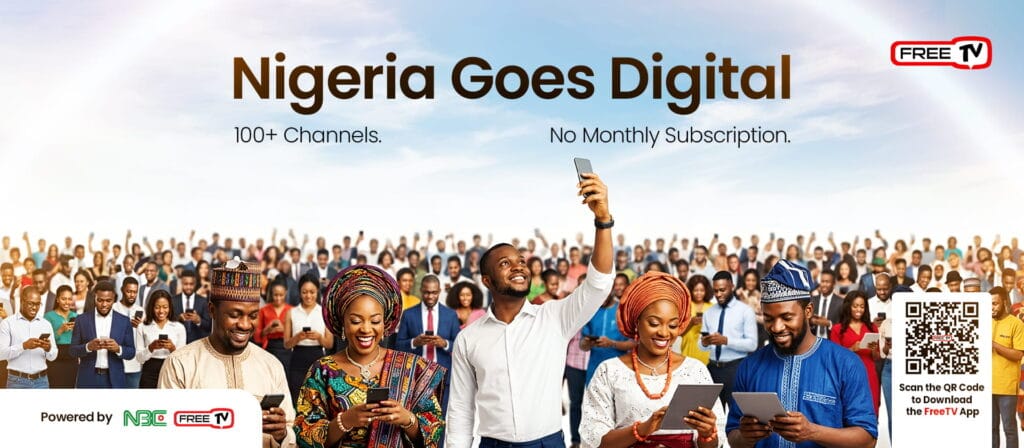
Charles Ebuebu, Director-General of the National Broadcasting Commission, made the government’s intention plain. “FreeTV speaks directly to President Bola Ahmed Tinubu’s vision of Renewed Hope towards expanding access, creating opportunity and ensuring that every Nigerian, regardless of location or income, can benefit from the digital economy,” he said. “With FreeTV, families across Nigeria can enjoy quality digital television without a monthly subscription, while our local content producers, technicians and young creatives gain new platforms and new jobs.”
The platform is being driven by the NBC in collaboration with the Nigerian Communications Satellite, known as NIGCOMSAT, using a hybrid system that combines satellite and mobile broadcasting technology. According to the NBC, the channel lineup spans news, sports, entertainment, education, children’s programming, and local content across multiple Nigerian languages, with at least 57 channels confirmed live at the time of writing.
Beyond television itself, the government says the project will support six regional production studios in Lagos, Abuja, Port Harcourt, Enugu, Kano, and Benin City, with each zone expected to create between 500 and 1,000 jobs within two years.
This is not a new idea that appeared overnight. I need you to understand that.
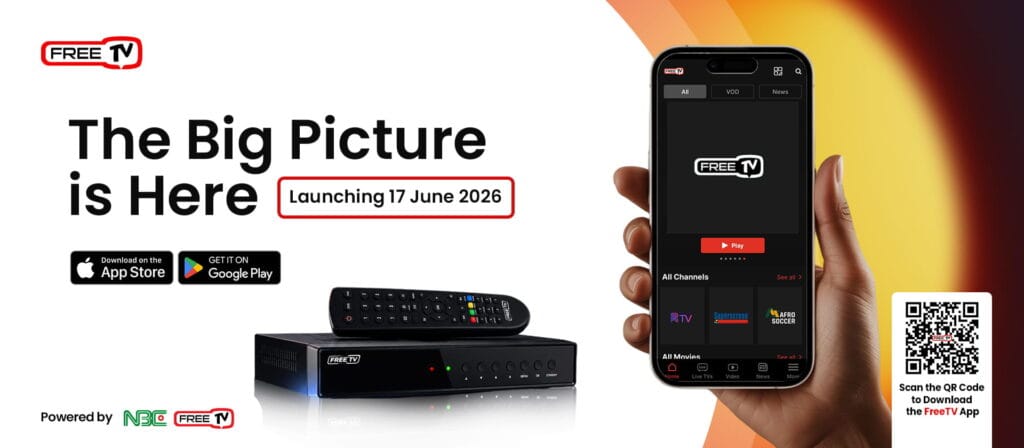
Nigeria first signed onto the International Telecommunication Union’s agreement to switch from analogue to digital television broadcasting back in 2006, with an original target completion date of June 2015. The Federal Executive Council approved the framework for that transition in 2012.
It did not go to plan. Funding challenges, policy reversals, and infrastructure gaps slowed the project for over a decade. Pilot rollouts launched in select states, including Plateau, but a genuine nationwide rollout never materialised, despite billions of naira reportedly spent along the way.
In August 2024, President Tinubu approved a ₦10 billion fund to revive the stalled project. That funding led to a strategic shift in 2025, moving away from the original plan of building expensive terrestrial transmission towers and toward the satellite-first model that became FreeTV.
So when you hear the government call this a landmark achievement, know that it is also, in part, the government finally delivering on a promise it first made nearly twenty years ago.
Here is where I need to slow down and be completely honest with you, because the marketing around this launch has not always matched the full picture.
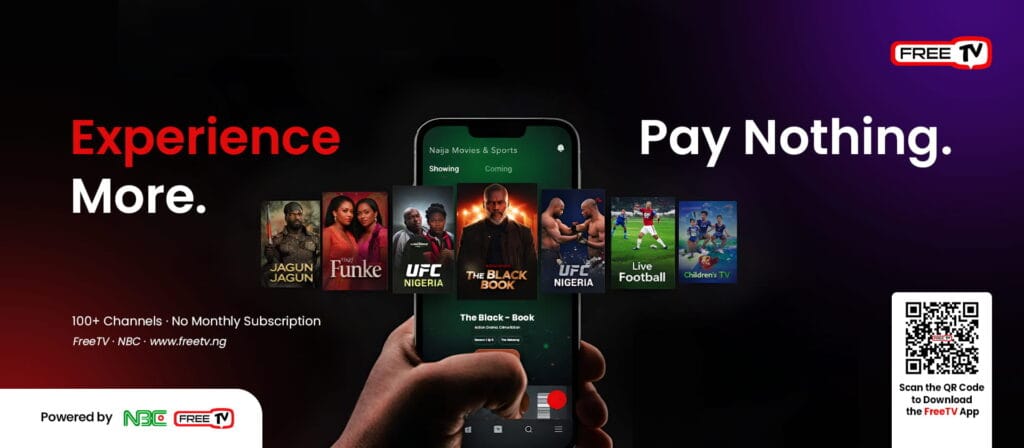
The ₦1,500 figure you are seeing attached to FreeTV is what the NBC describes as the Digital Access Fee, a once-a-year charge, not a monthly subscription. Years ago, when this concept was first floated under a previous administration, an NBC representative explained the structure plainly: a decoder would cost between ₦12,000 and ₦13,000, with a yearly digital access fee of ₦1,500 on top. Former Information Minister Lai Mohammed, presenting a set-top box to then Lagos Governor Babatunde Sanwo-Olu, described that yearly charge as painless, calling it a token once the box itself was purchased.
I think that framing is fair, as far as it goes. ₦1,500 a year is genuinely modest next to what DStv or GOtv subscribers pay every single month. But “free” television was never the full story. “Free” refers to the absence of a recurring monthly subscription, not to the cost of getting into the system in the first place.
And that entry cost, as you are about to see, is where this story gets complicated.
This is the part I want you to read carefully before you get excited.
Unlike a conventional Digital Terrestrial Television decoder, which you can connect to a basic indoor antenna, FreeTV relies heavily on satellite transmission. That means many households will need more than just a set-top box. You may need a compatible FreeTV decoder, a satellite dish, professional installation services, and dish mounting and alignment equipment.
For a lot of Nigerian families, those combined upfront costs could run into tens of thousands of naira before a single channel ever appears on the screen. The government has stated that households already using compatible free-to-air decoders may not need additional equipment, and that no new television set is required if your existing decoder supports DVB-T2 or DVB-S2 standards. That is genuinely good news for some households. But for the millions of Nigerians without compatible equipment already in place, the barrier to entry is real, and it lands hardest on exactly the low-income households this programme says it wants to reach.
I want you to hold both of these facts in your head at once. The ongoing cost of FreeTV genuinely is close to free. The cost of getting started is not.
Not everyone in Nigeria’s broadcast industry is applauding.
The Broadcasting Organisations of Nigeria, which represents television and radio stations across the country, has argued that this satellite-based, direct-to-home model differs meaningfully from the original digital migration framework Nigeria signed up to in 2006. Their concern is technical but important: a satellite system does not fully replace analogue terrestrial broadcasting in the way a conventional digital switchover would, and therefore does not immediately free up the valuable broadcast spectrum that the original DSO programme was designed to release for resale to telecom companies for 4G and 5G expansion.
BON has also raised a sharper, more structural question. Should the NBC be allowed to operate its own branded television platform while simultaneously acting as the regulator overseeing every other broadcaster in the country? Other industry groups have warned that rolling out this new structure without an updated legal framework could trigger regulatory disputes down the line.
These are not small objections. If you are a private broadcaster competing for the same audience FreeTV is now offering for nearly nothing, watching your own regulator launch a rival platform raises real fairness questions.

Here is the part of this story you have probably been waiting for. Does this actually threaten DStv?
The timing is striking, and I do not think it is a coincidence that industry watchers have noticed it. As FreeTV launched with its promise of over 100 channels at no monthly cost, MultiChoice’s DStv Stream, the company’s free streaming package, quietly reduced its own offering from 13 channels down to just four. What remains on that free tier is SuperSport Schools, SuperSport Play, Channel O, and TBN Africa. That is a significant retreat happening at the exact moment a free government alternative is expanding.
At the same time, MultiChoice has confirmed that DStv’s paid subscription prices will remain unchanged in 2026, breaking from the company’s usual pattern of annual price increases. That decision did not happen in a vacuum either. It reflects a pay-TV company already under pressure from global streaming platforms like Netflix, Disney+, and Amazon Prime Video, now facing a second front of competition from its own government.
MTN has also entered this fight, launching MTN One TV, a streaming platform that lets users pay with airtime or mobile money rather than a traditional card-based subscription, designed to lower the barrier for African households who are banked through their phones rather than their wallets.
So you have three forces converging on the same Nigerian living room at once. A government-backed free platform. A pay-TV incumbent freezing its prices and shrinking its free tier in response. And a telecom giant trying to make subscription television as easy as buying airtime. That is genuine competitive pressure, and DStv knows it.
So should you get FreeTV?
I am not going to tell you this is a simple yes or no decision, because it genuinely depends on your situation.
If you already own a compatible decoder, FreeTV is close to the best deal in Nigerian television history. Over 100 channels for ₦1,500 a year is not a typo, and it is not a trick. That is a real, government-backed offer.
If you do not own compatible equipment, you are looking at a real upfront investment, potentially tens of thousands of naira, before you see a single programme. For many households, that math will look very similar to simply paying for a basic DStv or GOtv package for a few months instead.
What I can tell you with confidence is this. The era of Nigerians having only one real choice for multichannel television is over. Whether FreeTV becomes a genuine mass-market alternative or remains a promising but underused government project will depend entirely on how the NBC handles the cost of that first decoder and dish, and how quickly the remaining channels beyond the current 57 actually go live.
For now, the government has put a number on the table. ₦1,500 a year. DStv and GOtv now have to decide what they are going to do about it.