


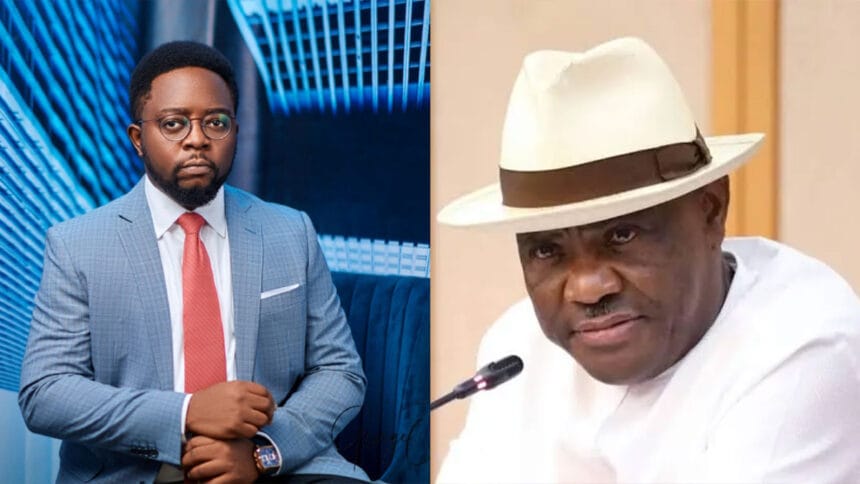
Federal Capital Territory Minister Nyesom Wike said on Friday that he would have shot Channels Television anchor Seun Okinbaloye through his television screen after watching the journalist express concern that Nigeria was drifting toward a one-party state.
Wike made the statement during a live media chat in Abuja on Friday, April 3, 2026, which aired on multiple television networks.
“I was thoroughly surprised yesterday when I was watching Seun’s Politics Today. If there was any way to break the screen, I would have shot him. How can an interviewer say we cannot allow a one-party state?” the minister said.
Wike immediately added that he did not mean the remark literally. “I am not saying I will kill him. I am just angered that he made that kind of statement on national television. This is not the kind of journalism I have seen people do,” he said.
The statement has triggered immediate condemnation from human rights organisations, civil society groups, and public figures across Nigeria.
The controversy began with Thursday’s edition of Channels Television’s Politics Today programme. Okinbaloye was anchoring a discussion on the leadership crisis inside the African Democratic Congress and INEC’s decision to withdraw recognition of the David Mark-led National Working Committee following a Court of Appeal ruling.
Okinbaloye said: “I am particularly pained because what makes the race very interesting is when it is competitive, not when only one party stands in the middle of the ballot. There are a lot of experienced men in the ADC. It looks like one of the hopes of the opposition going into 2027. If this hope is dashed, we are doomed democratically.”
That statement is what drew Wike’s reaction. The minister accused Okinbaloye of abandoning journalistic neutrality and inserting his personal opinion into a political matter on national television.
Okinbaloye’s comments were an expression of editorial concern about democratic competition. Whether that crosses a professional line is a matter of media standards. Whether a serving minister’s response to that concern should include language about shooting a journalist is a separate and more serious question.
Condemnation was swift and came from multiple directions.
Amnesty International Nigeria described Wike’s remarks as “reckless and violent,” saying they violated Nigeria’s broadcasting code. “What Wike said carries the danger of normalising violence and encouraging the targeting of journalists for just doing their job. This level of violent intent coming from a member of Nigeria’s federal cabinet is unlawful and unacceptable,” Amnesty said. The group called on Wike to withdraw the statement and apologise immediately.
The Conference of Professionals in the Peoples Democratic Party called on the Inspector General of Police to immediately invite Wike for questioning over his remarks, and urged international bodies to impose sanctions including a visa ban on the minister.
Comedian and activist Mr Macaroni also responded publicly, saying: “This is a country where public servants become tyrants because they know there is no consequence.”
Wike’s office moved to contain the fallout on Saturday. His spokesman said the minister never intended physical harm and that the remark was made in a “hyperbolic context, which was clearly without intent.” The spokesman added that Wike and Okinbaloye had spoken by telephone and that Okinbaloye “understood what the minister meant.” Channels Television has not issued an independent statement confirming that characterisation.
Nigeria’s press freedom index stands at 122 out of 180 countries, making it one of West Africa’s most dangerous and challenging environments for journalists. Media professionals in Nigeria are routinely monitored, attacked, and arrested, particularly during electoral periods.
The 2027 general elections are now less than two years away. The ADC crisis, which triggered this exchange, has raised genuine questions about the viability of opposition parties ahead of that vote. INEC’s withdrawal of recognition from the David Mark faction followed a Court of Appeal ruling ordering parties to maintain the status quo from an earlier decision. The legal dispute inside the ADC has not been resolved.
This is not the first time Wike has generated controversy through aggressive public statements directed at critics or opponents. As Rivers State Governor, he became known for combative press interactions and a willingness to publicly name and confront adversaries. His style has remained unchanged since his appointment as FCT Minister under President Bola Tinubu’s administration.
The broader context matters. Concerns about Nigeria’s democracy narrowing ahead of 2027 are not limited to Okinbaloye. Multiple opposition figures, civil society organisations, and legal analysts have raised similar questions about INEC’s handling of the ADC matter and what it signals for competitive elections.
Whether Channels Television will respond formally to Wike’s remarks has not been confirmed. Whether the Inspector General of Police will act on the CP-PDP’s demand to invite Wike for questioning has not been confirmed. Whether Wike will issue a formal apology or retraction, as demanded by Amnesty International, remains unconfirmed.
While this story is developing. Africentra will update as Channels Television, the police, and the presidency respond.