



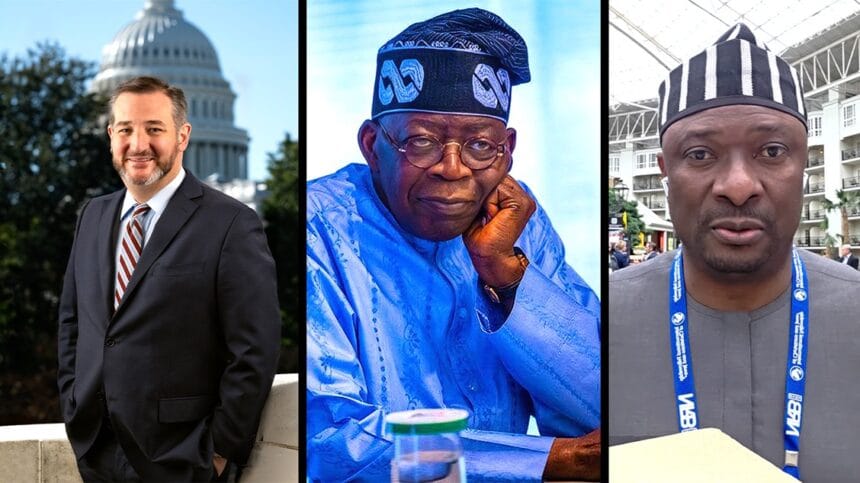
A bill currently before the United States Senate would require the Secretary of State to designate Nigeria as a Country of Particular Concern, impose targeted sanctions on named Nigerian officials, and freeze assets held anywhere in the global financial system, including in the United Kingdom, Canada, and the European Union.
Senate Bill 2747, titled the Nigerian Religious Freedom Accountability Act, was introduced by Senator Ted Cruz and co-sponsored by Senator James Langford, Republican of Oklahoma, in the 119th Congress. It has not yet passed into law.
Franc Utoo, a Nigerian-American lawyer and policy researcher based in Oklahoma, has been briefing US congressional offices on the bill and confirmed to Africentra that he has a scheduled meeting with Senator Langford to advance its passage. Utoo is a citizen of Benue State and a native of Yelewata, a community where he says more than 200 people were killed in attacks by Fulani armed groups. He has been working directly with members of the US Congress on the issue of Christian persecution in Nigeria.
“God will prevail and we shall prevail,” Utoo said in a public address on the bill that has since circulated widely on social media.
So What Does the Bill Actually Says?
Aso Read: El-Rufai Denies N423bn Allegation, Accuses Ribadu of Ordering Unlawful Arrest
The Nigerian Religious Freedom Accountability Act would impose targeted sanctions on Nigerian officials who facilitate religious violence or enforce repressive blasphemy laws. It requires the US Secretary of State to redesignate Nigeria as a Country of Particular Concern under the International Religious Freedom Act.
More Buzz
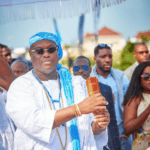

The categories of officials covered are broad. They include federal executives, National Assembly members, governors, judges, law enforcement agents, and military officers who promoted, supported, or were silent in the face of violence by non-state actors including Boko Haram and ISIS-West Africa.
The bill invokes Executive Order 13818, signed during Trump’s first term in 2017. That order authorises the United States to freeze assets, block property, and impose travel restrictions on designated individuals. The Secretary of State would be required to transmit a list of designated Nigerians to the Senate within 90 days of the bill’s enactment.
Also Read: NNPC CEO Visits Dangote Refinery, Calls It a Symbol of National Pride
A companion bill has been introduced in the House of Representatives. It has not yet been scheduled for a committee vote in either chamber.
And Here is What It Means for You a Nigerian
The financial reach of this bill is what has drawn the most concern inside Nigerian political circles, and Utoo was direct about why.
The bill operates alongside the Global Magnitsky Act, which the United States, United Kingdom, Canada, and the European Union have each adopted in domestic law. That framework extends the reach of US sanctions to any financial transaction that touches the dollar system. Because the majority of international transactions clear through US correspondent banks, a sanctioned individual’s accounts, investments, and property can be affected regardless of which country holds them.
For Nigerian officials with assets in London, Zurich, Dubai, or Toronto, that is a real and immediate exposure. Utoo described it plainly: “Any transaction, any phone, any bank accounts, any property belonging to the sanctioned individuals that touched the US financial system will be blocked.”
What is Africentra’s analysis Be?: that characterisation is broadly consistent with how Magnitsky-style sanctions function in practice. The precise scope would depend on which individuals are formally designated after enactment, a process that has not yet begun.
Understanding Utoo’s Personal Stakes in the Push for Passage of the Bill
Franc Utoo is not a distant observer of this issue. He grew up in Yelewata, Benue State, a community that lost more than 200 residents to attacks by Fulani armed groups in 2025. He has watched, he says, as successive Nigerian governments failed to prosecute those responsible.
His legal and policy work in the United States is built around one argument: that the failure of Nigerian officials to stop the killings is not incompetence. It is complicity. He has on several occasions cited a statement attributed to a former Nigerian head of state, General Sani Abacha, that “any insurgency lasting more than 24 hours has government involvement”, as the framework for understanding the scale of institutional failure.
“The government has a hand in it,” Utoo said. “Different people in government, at the state and national level, have a hand in all these killings happening in Nigeria.”
That is a serious allegation. It is his assessment, based on his research and advocacy work. It is not a finding of any court or independent body. Africentra is reporting it as his stated position.
According to Open Doors‘ 2024 data, 82 percent of the 4,998 Christians killed worldwide in 2023 were Nigerian. Between 2009 and 2023, more than 52,000 Christians and at least 34,000 moderate Muslims were killed in faith-based attacks by Islamist groups in Nigeria, with approximately five million people displaced.
In 2025 alone, jihadist violence killed more than 7,000 Christians and led to the abduction of an additional 7,800, according to figures cited by US legislators when introducing the House companion bill.
Twelve Nigerian states enforce Sharia law, including blasphemy provisions. Nigeria’s federal government also criminalises blasphemy at the national level.
The bill has not passed. It remains in the Senate Committee on Foreign Relations. No vote date has been confirmed.
Why The Response from Nigeria is Not Purpolar
The Nigerian government has not issued a formal written response to S.2747 at the time of publication. Nigerian officials have publicly described the bill as an attempt to inflame religious tensions and misrepresent the country’s security situation.
Utoo rejected that framing without hesitation. He argued that official opposition to the bill is driven by fear of personal sanctions rather than concern for Nigeria’s international standing.
“It’s not about Nigeria,” he said. “It’s for them. It’s not for all of us.”
Africentra has not independently confirmed which specific Nigerian officials may appear in any US government report connected to this legislation. And at the moment, no Nigerian government spokesperson has confirmed or denied the existence of such a list.
Nigeria was previously designated a Country of Particular Concern by the US State Department in 2021 under the first Trump administration, then removed from that list the same year by the Biden administration. That reversal drew sharp criticism from religious freedom advocates and Christian communities in Nigeria’s Middle Belt and southern states.
S.2747 would make the designation mandatory by statute, removing executive discretion to reverse it. That is the structural difference between this bill and previous policy moves on Nigeria, and it is the element Utoo says Nigerian officials fear most.
What we still have not confirmed is this. The bill has not passed. Its enactment is not confirmed.
The existence of a specific, formally compiled US government list of named Nigerian officials linked to this legislation has not been publicly confirmed by the State Department or any US official. Utoo referenced such a list in his address. Africentra cannot verify its contents.
Claims that specific governors, judges, or security officials will be designated under this bill if it passes are possibilities under the bill’s framework, not confirmed outcomes.
Whether Utoo’s meeting with Senator Langford and other legislators will influence the bill’s progress through committee has not been a question everyone is asking. It is also right to say that Utoo is not the only advocate fighting for the bill to be passed. There are other Nigerians and non-Nigerians who have been working tirelessly to see the bill become a reality.