
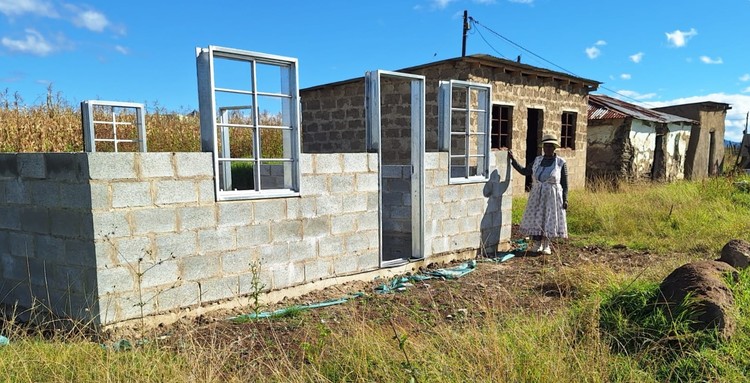
The government promised Nomonde Mboyi a house. She got tired of waiting and built one herself, using her pension.
Mboyi, 67, lives in Ndakeni village in the Mbizana area of the rural Eastern Cape. In 2019, heavy wind and rain flattened two of her mud houses and left the third with a leaking roof and cracked walls. Officials later told her a replacement house was coming.
It never came. So she started saving.
Month after month, Mboyi set aside part of her old-age grant from the South African Social Security Agency (SASSA) to buy materials and pay builders, GroundUp reports. When the money ran out, construction stopped until she had saved enough for the next stage. Her two-room mud-brick house now needs only exterior plaster and finishing. She plans to move in by December.
The house the government started for her stands nearby. It has a foundation and partial walls. Nothing more.
Mboyi’s story is not a one-off. It is the whole programme.
In 2023, the Eastern Cape Department of Human Settlements hired ZIBSIPRO (Pty) Ltd to build 200 replacement homes for storm victims in the area, at a cost of about R34 million. That works out to roughly R170,000 per house.
Three years later, not one of the 200 is finished.
According to the contractor, building only started in earnest around October 2024. By November 2025, the company had left the site. At a municipal meeting in February 2026, residents offered to finish the houses themselves. They were told to wait.
They are still waiting.
The department says it terminated ZIBSIPRO’s contract in the 2025/26 financial year for poor performance. Spokesperson Yanga Funani told GroundUp the project will restart, with houses already under construction getting priority and the rest depending on available funding.
The contractor tells a different story. Director Palesa Phara said the department had not paid the company for about a year, making it financially impossible to keep working. She said she did not know the contract had been terminated, though she admitted receiving a letter of default. She blamed delays on geotechnical studies, slow approvals, a foundation design she called over-engineered, an instruction to slow down, and labour disputes that blocked access to the site.
The department did not answer her allegations. The Winnie Madikizela-Mandela Local Municipality did not respond at all and referred questions to the province.
South Africa’s old-age grant is meant to cover food, medicine and the basics. It was never designed to build homes.
Yet a woman living on it has achieved what a R34 million contract could not. Eskom will only connect her to electricity once the house is waterproof, so the final coat of plaster is the last step between her and the lights.
The 199 other families on the government’s list have no such finish line. Their houses depend on a contract that has collapsed, a department promising to restart and money it has yet to find.