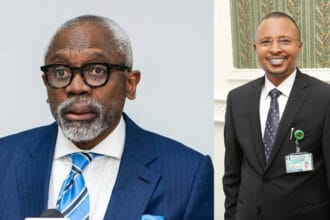


Channels Television anchor Seun Okinbaloye has broken his silence following FCT Minister Nyesom Wike’s statement that he would have shot the journalist through his television screen for raising concerns about Nigeria drifting toward a one-party state.
Speaking from Channels Television’s Abuja studio, Okinbaloye thanked supporters, stood by his journalism, and delivered a direct message to anyone watching.
“Let me declare: I am not afraid, and I will never be intimidated,” he said.
The statement was measured, firm, and without personal attack. It was the response of a journalist who understood exactly what was at stake in making it.
Okinbaloye opened by acknowledging the wave of support that followed Wike’s remarks on Friday, April 3.
“I sincerely want to thank civil society organisations, our viewers, for your love and your comments and your solidarity, both local and international organisations. For your sweet interventions and for lending your voices. The support is deeply appreciated and reinforces our collective commitment to truth and accountability,” he said.
He then addressed the substance of the controversy directly, without naming Wike.
“The fact remains that our democracy is in danger if we allow one-way traffic. This is not a warning to the opposition or to any one party, but to all Nigerians who believe in the development of our nation,” he said.
On the question of safety, he was precise. “On a time like this, particularly during an election period, clear and consistent assurances of safety are critical. We must not create an environment where such statements can be exploited by those with harmful intentions.”
He then addressed the profession he has built his career around. “Journalism grounded in ethics and global best practices remains a duty, not a concession to power. We may disagree, and as humans, we may err, but never descend to the language of harm.”
He closed with a statement of intent. “I will continue to do what I love: ask the hard questions, hold power to account, and work in the interest of Nigeria and its progress. If that commitment comes at a cost, so be it. Truth, my friend. Truth.”
Okinbaloye’s response carries weight because of what he did not do. He did not retreat. He did not accept Wike’s aide’s framing that the remark was merely hyperbole and that the matter was resolved. He acknowledged the clarification, then held the line.
His warning that “we must not create an environment where such statements can be exploited by those with harmful intentions” is a direct rebuttal of the position that words from a sitting minister carry no consequence. It places the burden of responsibility squarely where it belongs: on the person who said them.
Okinbaloye’s statement does something important for Nigerian journalism. It refuses to normalise the exchange. It names the danger without dramatising it. And it states plainly that the work continues regardless of the personal cost. That is the standard the profession requires, and it is rarely stated so clearly under pressure.
Okinbaloye is not standing alone. Since Wike’s Friday remarks, condemnation has come from multiple directions.
Amnesty International Nigeria described Wike’s statement as “reckless and violent” and demanded a retraction and immediate apology. Former Vice President Atiku Abubakar’s media office condemned the remarks as a “disgraceful threat” against a frontline journalist. The ADC also condemned the minister’s language. The Conference of Professionals in the PDP called on the Inspector General of Police to invite Wike for questioning.
Wike’s aide described the remark as hyperbole and said the minister and Okinbaloye had spoken by phone. Okinbaloye did not confirm or deny that phone call in his public statement. He did not say the matter was resolved.
Whether Wike will issue a formal apology as demanded by Amnesty International remains unconfirmed. and whether the Inspector General of Police will act on the call to invite Wike for questioning remains unconfirmed. While we still hope that Channels Television will issue an institutional statement separate from Okinbaloye’s personal response has not been confirmed at the time of publication will keep an eye as the situation progress.