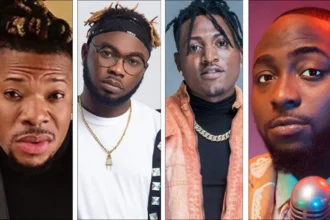
Brymo
Brymo, originally Olawale Oloforo by birth, is a prolific singer, songwriter, and performer whose musical career started as early as 1999 while still in secondary school.
He was subsequently signed to the record label Chocolate City in 2010, and even after this partnership was broken in 2013, he continued to establish himself. Brymo got his first major break with his single “Ara,” which he released in 2012. It was one of the few songs to top the Nigerian charts in 2012. This was an absolute hit since it was played nonstop in nightclubs and at social events as if it were the national anthem. Despite the song being in Yoruba, the majority of listeners knew the lyrics.
When “Good Morning,” his next single, was released, it immediately became a rave. Afterwards, “Down,” the hit song, debuted. Back then, this song earned him one of the most views on YouTube.
There’s no doubt that this artist experienced his high points when the entire nation seemed fascinated by his songs. But the singer, in a tweet in May 2020, disclosed that the top five countries where his “YELLOW” album has been streamed most include the US, UK, Ghana, and Canada. It makes you wonder, right?
The US, Ghana, The UK, and Canada in that order are the 2nd-5th places where I’m being streamed the most… At the moment the home crowd continues to outplay everyone…. thank you for tuning in guys, I love you all…💛💛💛💛
— Ọláwálé Ọlọ́fọ̀rọ̀ (@BrymOlawale) May 15, 2020
Johnny Drille
Speaking of Johnny Drille, This artist crafts love songs after love songs that serve as a soundtrack for every romantic at heart. He boasts a refined literary touch to his music that is nearly nonexistent in the music scene today. After competing in the sixth season of Project Fame West Africa in 2013, he was signed to Marvin’s record label in February of that same year and has since carved out a remarkable niche for himself in the Nigerian music industry.
With catchy songs that make you want to fall in love, the “Wait for Me” crooner has raised the bar for music as we know it. However, the artist recently shared a video of himself singing his song “Before I Let It Go” on Instagram with the caption “You people underrate this song from #BWFA too much & it’s paining me,” in reference to his album “Before We Fall Asleep.”
The Cavemen
When you picture a representation of contemporary highlife, The Cavemen come to mind. The musical duo from Nigeria, who made a big splash on the Nigeria music scene in March 2018 with their hit song “Miri Osiso.” It’s no surprise that they took home the ‘Best Alternative Album’ Headies Award in 2020. Their win was categorized as ‘well deserving’ by fans nationwide.
However, there is a notion that these artists, despite dominating the charts, probably perform better outside of Nigeria.
Famously Outnumbered
No compelling evidence exists to support the argument that these artists’ genres of music are not sustainable in Nigeria. After all, a good number of people love soul music and highlife music.
The only question is, are Nigerians part of that demographic? According to statistics from several online sources, jazz, reggae, highlife, and afrobeat are the most popular musical genres in Nigeria, while soul music and R&B are mostly preferred by a small group of people who are fast becoming extinct. This is why mainstream musicians like Davido, Wizkid, and many others continue to thrive actively in Nigeria.
Which raises the question of why Brymo, Johnny Drille, and Cave Men have thriving careers yet are underrated in the country where they started. We can only answer this question by delving deep into the musical roots of Nigeria. But first, let us examine the trends, that have influenced Nigeria’s music industry over the years.
The Evolution of Nigerian Music
Jùju survived the rise of rock ‘n’ roll and funk in Europe and America by adapting to the times and fusing modern guitar sounds with traditional rhythms in Nigeria.
By the 70s, amongst the greatest artists were Fela Kuti, Ebenezer Obey, and King Sunny Ade. And they are all featured in the afrobeat and juju music genres. Nigerians were captivated by this era and its genres, and they left a lasting impression on our collective memories. These originals have greatly contributed to every subsequent generation of Afrobeat.
With contemporary musicians paying homage to them through their musical or dance performances. Nigerians have become familiar with and appreciative of these major musical genres out of habit and constant exposure, that explains why any departure from this trend receives little to no attention.
The Musical Taste of the Average Nigerian
One common use of music in the Nigerian society is pure enjoyment. Another common use relates to music’s ability to inspire dance and physical movement. In the past, our country’s musical icons employed music as a medium for communicating deep ideas about humanity, politics, and religion. That trend has long been discontinued, as not all lyrics convey deep meaning these days. The average Nigerian wants to dance to the sound of music. They want rhythmic sounds that move them to dance, that are fast-paced and repetitive, all of which are inherent in afrobeat music.
Take, for instance, nightclubs. The moment a song tempo drops to an R&B/Soul, people stop dancing and begin to converse, and this creates an atmosphere of sobriety. The only thing is, the average Nigerian wants to be lost in the music. They want to ‘jaiye’ because they seek an escape from everyday realities. Though we have a few exceptions to this rule, who would rather listen to an inspirational playlist or a slow love song, there are even scenarios where people crave these genres of music to help them get through breakups or find motivation during low-spirited times.
But categorically, these genres do not top the Nigerian musical charts as often as some other popular genres do. Even, Nigerians are more likely to appreciate an afrobeat artist’s rendition of a love song than they are of a traditional soul music love song.
This is a laughable observation, which is also sadly true. Most Nigerians are not opposed to soul music, but they like it better when it’s mixed with something a little more upbeat, like afrobeat or pop. Not because soul music is completely uninteresting, but because the majority of Nigerian music lovers have a preference for entertaining music; emphasis on the word “majority”.
Despite the fact that slow, romantic love songs and songs about love in general are not unappealing to the typical Nigerian, how they are delivered is what matters. like in the case of the celebrated vocalist Chike.
Because of the familiar feel of Chike’s music and the wide appeal of many of his songs, almost everyone can appreciate them and relate to them. His love songs are specifically written to reflect how Nigerians view love. Additionally, his songs are danceable! This is why most listeners can identify with his songs even if they are not fans of that particular genre.
Also the distressing level of tension brought on by the socioeconomic instability in Nigeria is another factor, because it has led to a strong desire for music that reduces stress.
You finally comprehend why people are better predisposed to upbeat, danceable music than gloomy music. It is already stressful for the average Nigerian to have to deal with the unpredictable economy of the nation and the daily hassles. It makes perfect sense that most people may not want music that evokes strong feelings that are not the happy type.
Regardless, big ups to all Nigerian artists who make the world dance, make Nigerians feel at ease, and top global charts. Whatever your genre, we value you all.
And while some Nigerians have yet to develop a voracious appetite for some underappreciated musical genres, it is reassuring to know that the artists of these unpopular genres can still grow a massive fanbase in other countries while they perfect their craft.
#brymo #thecavemen #jonnydrille